LooksLab guide
Gonial Angle: What's Ideal and How to Measure It
Learn what the gonial angle means, how study values differ from an ideal, what a side photo can measure, and which changes affect jaw contour.
The gonial angle, also called the mandibular angle or jaw angle, is the bend at the back corner of your lower jaw, where its rear edge meets its lower border. In one CT-based clinical sample, right-side averages for adults aged 20–59 were about 120–121° in men and 125–126° in women, but no number has been shown to be ideal for everyone, and a side-photo tracing is not the same as the bone measurement.
This guide is for adults 18+, including men and women. Use the study values to understand the numbers, then the photo worksheet to make a consistent record of your own profile.
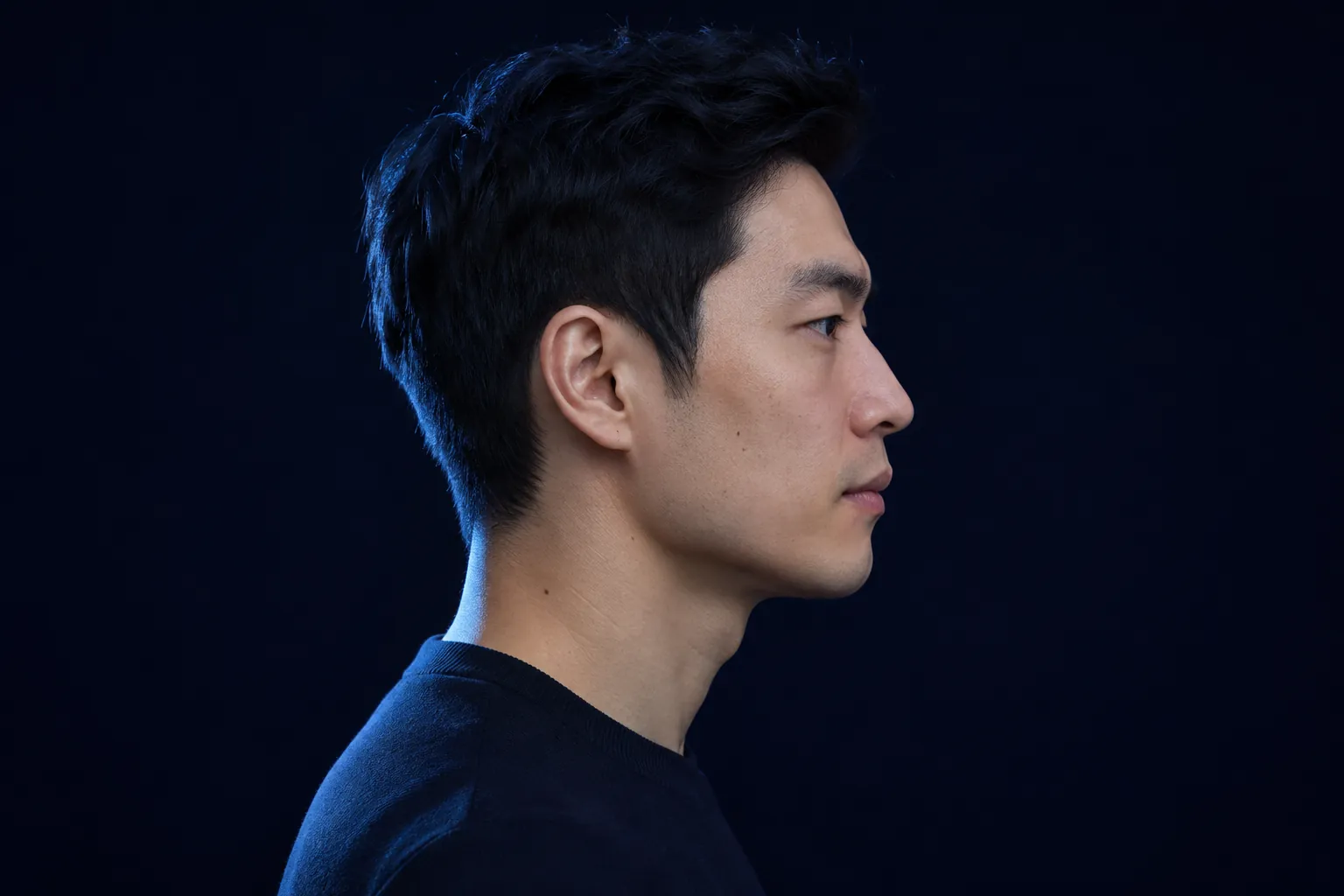
Fictional illustration, not a patient or treatment result.
Is 120 or 130 degrees the ideal gonial angle?
Neither number is a universal ideal. With the same method, 120° is more closed than 130°; that describes how two lines meet, not which face looks better. The difference between a clinical average and an appearance preference matters here.
For men, Mommaerts' 2016 internet photo survey reported a preferred profile angle of about 130°. It used black-and-white photographs of celebrities and non-celebrities to guide implant design. That was a panel's preference among photos, not a measured norm or treatment target.
In Mommaerts and Cleymaet's 2023 online survey, raters judged jaw features in frontal and profile photos of celebrities and laypeople. Photos rated favourably by at least 80% of raters averaged 125.5°; the others averaged 129.1°. The difference was not statistically significant (p = 0.28), although the authors still present 125.5° as their attractive value.
That survey used white female faces. Of its 46 assessors, 38 were men and 32 performed facial contouring surgery. Its methods and results describe one photo set and one rater group; they do not show that moving your angle toward 125.5° would make you look better.
What does a high or low gonial angle mean?
A high gonial angle is larger and more open; a low gonial angle is smaller and more closed. “High” describes the number, not the corner's height beside your ear. Both 120° and 130° are wide, or obtuse, angles—not acute ones. In the side view, a more open angle makes a blunter rear corner and a more closed angle makes a sharper one, though skin, fat and muscle affect what you actually see.
A higher angle goes with a steeper lower jaw border in Bajracharya and colleagues' 2021 study. Among 166 orthodontic patients aged 17–30 in Nepal, the groups were sorted by the steepness of the lower jaw border (mandibular plane angle). The group X-ray averages were:
- Steep-border pattern: about 133°.
- Average pattern: about 124°.
- Flat-border pattern: about 120°.
These describe groups of orthodontic patients. A selfie cannot place you in a group or tell you how your teeth fit together.
A high number on its own is not a diagnosis or a reason for treatment. No at-home method is shown to lower the bone angle in an adult; the section on changing your gonial angle, below, covers what each option can and cannot do.
The slope of the lower jawline alone also cannot give you this angle: you need the rear-border direction too. A study recording both gonial and mandibular-plane angles treats them as separate measurements.
Where exactly is the gonial angle?
The lower jaw, or mandible, has a body extending toward the chin and a ramus rising at the back. The rear corner is the gonion. One clinical method places a straight line along the rear edge of the ramus and another along the lower jaw border, then measures where they meet.
Keep the rear corner separate from front-view jaw width and the turn from beneath the chin into the neck; those are different lines in different views. Even within the side view, one study's measurement definitions list the gonial angle separately from the slope of the lower jaw border. A “square jaw” is an appearance description; it does not mean the side-view angle should be 90°.
For width across the lower face, use our square jaw guide. A chin tip that looks set back is another question; the weak chin guide focuses on that part of the profile.
What is a normal gonial angle for men and women?
Published averages describe particular samples, rather than a normal interval for everyone. The following adult study values come from Bakan and colleagues' 2022 study of people with teeth in a clinical sample in Türkiye. All three adult age-group rows use the right side, measured on panoramic images reformatted from cone-beam CT (CBCT).
| Age | Women, mean ± SD (number) | Men, mean ± SD (number) |
|---|---|---|
| 20–39 | 125.83 ± 7.87° (28) | 120.27 ± 6.15° (22) |
| 40–59 | 124.82 ± 5.83° (53) | 120.66 ± 6.22° (46) |
| 60–77 | 124.81 ± 5.91° (18) | 122.18 ± 7.16° (20) |
SD (standard deviation) shows the spread around each average. The groups overlap heavily, so an average cannot classify one person's number as male or female. All three rows come from the same study.
Women had significantly higher averages in the 20–39 and 40–59 age groups: right-side p = 0.009 and p = 0.001, respectively. In the study's 60–77 group, the gap was smaller and not significant (124.81° vs 122.18°, p = 0.227). The study found no age correlation.
An earlier mixed-age study by Upadhyay and colleagues found no significant sex difference. In its oldest group, participants without teeth averaged 6° higher than those with teeth. That is a group difference, not a prediction for any one person.
How is the gonial angle measured—and can I use a selfie?
A clinician identifies bone borders or landmarks on appropriate imaging. Ask which method and side your number represents. Besides the border-line method, you may see Ar–Go–Me: articulare, gonion and menton. These are skeletal landmarks; the photo study uses different surface landmarks.
If you already have a reading, keep its context with it: “right side, CBCT image, border-line method” is more useful than “my angle is 130°.” Ask the examiner to show you which two directions were measured.
Choose the view that answers your question:
| View | What it can show | What it cannot establish |
|---|---|---|
| Front photo | Frontal outline, relative widths and left-to-right appearance | The skeletal side-view gonial angle |
| True-side photo | Visible skin and soft-tissue contour | Exact bone borders or your individual clinical angle |
| Clinically indicated imaging, interpreted professionally | Bone measurements under a stated method | A personal beauty score or automatic need for a procedure |
In a study of 120 people aged 12–22, standardized profile photos and X-rays produced similar group averages, but the gonial-angle correlation was r = 0.65. So a photo can match the X-ray on average and still differ for you. Researchers used marked landmarks and a fixed camera distance; a home tracing is less controlled. The study did not test front-facing selfies.
Use imaging that a clinician considers necessary for your care; do not seek an X-ray just to obtain a beauty number.
How can I record the angle on a side photo at home?
This gives you a rough photo estimate, not a clinical measurement. Its value is consistency: the same setup and the same lines, so you can compare photos fairly.
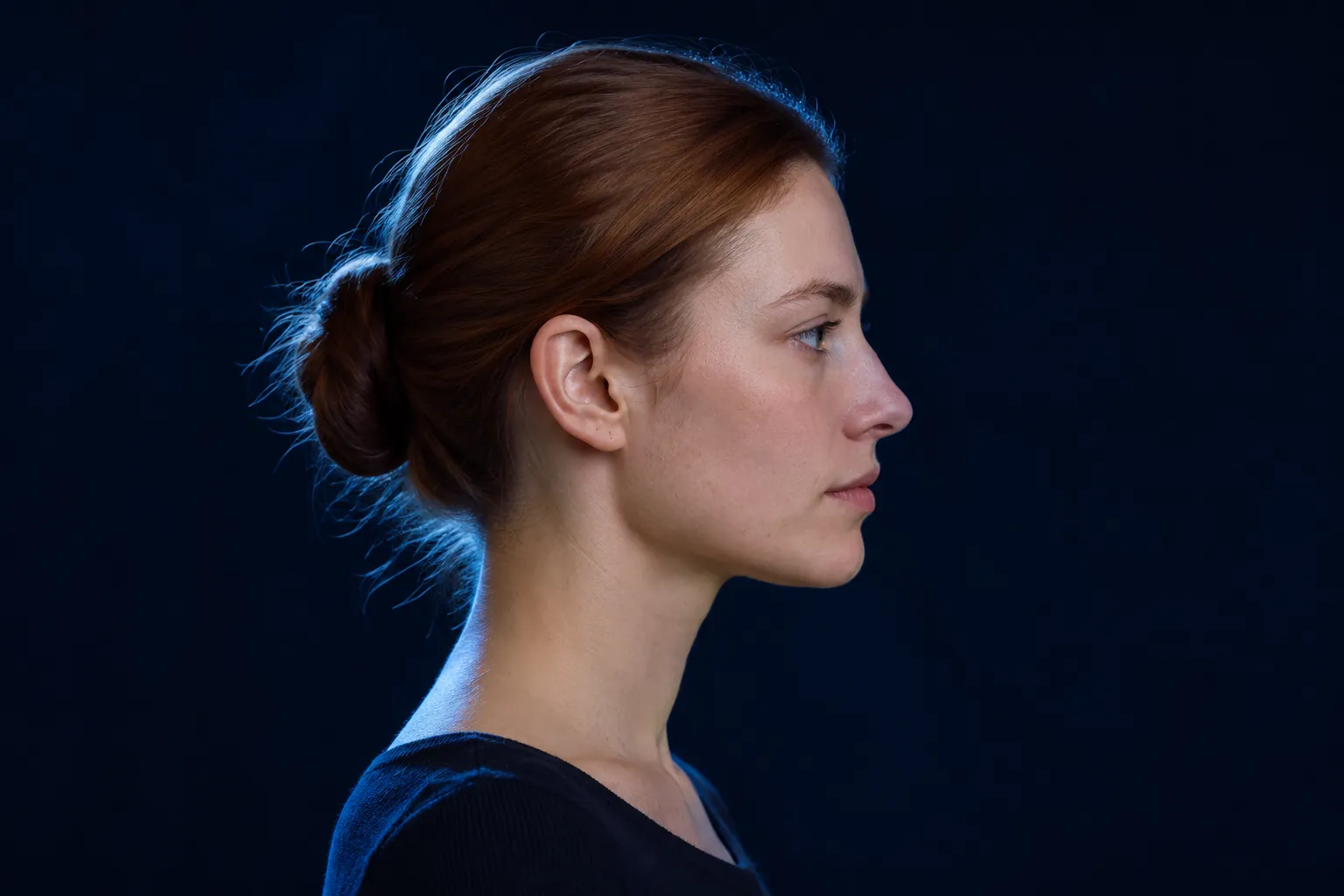
Fictional illustration, not a patient or treatment result.
- Set a steady camera at eye level. Use a timer, tripod or helper. Leave space around the head and avoid an extreme close-up.
- Take a true side view. Look straight ahead with the camera beside you. Keep your head comfortably level, lips relaxed and jaw unclenched. Do not jut your jaw, tuck your chin or stretch your neck.
- Make the outline visible. Tie hair back, use even light and turn off beauty filters. Note where facial hair or shadow hides the corner or lower border.
- Save the setup. Record phone, lens, distance, camera height, side and lighting. Photograph each side separately if comparing them; take a separate front photo for frontal tools.
- Draw only what you can see. Place one straight guide along the apparent rear jaw direction and another along the lower outline. Extend them to meet and label the result photo contour estimate. Do not guess through a hidden border or substitute the ear for a bone landmark.
- Read the wide angle and redraw once. Choose the angle on the inside of the jaw, the one above 90°. Hide the guides, draw them again and note whether using different parts of the outline changes the answer.
Why does my angle app show 50 degrees?
Two intersecting straight lines form neighbouring angles that add up to 180°. In a hypothetical example, if the app reports the small angle on the other side of the line, 50°, the wide angle is:
180° − 50° = 130°
Check which region the app highlights; do not automatically subtract every displayed angle from 180°. This is geometry, not a conversion from skin contour to bone.
What if I get 130 degrees and then 138?
Record both readings. On an unchanged picture, the angle changes when you tilt a guide line; moving the corner marker without changing the lines changes nothing.
| Worksheet field | Your entry |
|---|---|
| Setup | Phone/lens, distance, camera height and light: ___ |
| Side and pose | Left/right; comfortable level head; relaxed expression: ___ |
| Visible or hidden contour | Rear direction and lower border visible? Hair/shadow obstruction? ___ |
| First tracing | Wide photo contour angle: ___ |
| Independent redraw | Second estimate: ___ |
| Source of disagreement | Which guide direction or visible segment changed? ___ |
| One useful question | What do I want clarified? ___ |
Hypothetical completed note: “Right profile, same phone and light. First tracing 130°, second 138°. I used a different stretch of the curved lower outline. I cannot assign one dependable value from this photo.” This shows disagreement between tracings, not bone change or a measured error margin.
If the border is hidden, write “not measurable from this picture.” For the rest of the outline, use the whole side-profile check to separate nose, lips, chin and neck.
Can you change your gonial angle—or just how your jaw looks?
Nothing you can do at home is shown to change the bone angle in an adult. The AAO's mewing statement and a separate randomized gum-chewing trial in adults do not support mewing or gum chewing as ways to do it. Non-surgical options target muscle, soft tissue or framing; surgery reshapes or moves the bone.
Start with the change you want: a clearer edge, less width, more projection or different framing. Bone size, masseter muscle bulk and fat all contribute to lower-face appearance.
The medical rows below are information for a consultation, not recommendations.
| Option | What it targets | Limit or risk to understand |
|---|---|---|
| Camera, light and head position | How you record the outline | A different-looking picture does not establish changed bone geometry. |
| Hair or beard styling | Visible framing | Compare styles in matched photos as a presentation choice. |
| Changes in facial fullness | Soft tissue over the underlying frame | An angle does not establish excess fat or predict a response to weight change; fat volume is a separate factor from jaw-bone size. |
| Masseter botulinum toxin, often called Botox | Temporarily reduced chewing-muscle bulk | Risks include temporary chewing weakness and facial or smile asymmetry. Long-term bone effects remain uncertain; this is not a treatment for choosing a skeletal angle. |
| Jawline filler | Added tissue volume for definition | FDA's VOLUX XC indication covers adults over 21 with moderate to severe loss of jawline definition. The chance is low, but accidental injection into a blood vessel can cause tissue death, blindness or stroke, with potentially permanent effects. |
| Jaw-angle implant | Added height, width or contour around the existing jaw | Risks include malposition, asymmetry and revision. Disrupting the muscular sling can cause masseter retraction and hollowing. |
| Bone contouring or jaw repositioning | Bone shape or position | Risks depend on the operation. Angle reduction can cause bleeding, a blood collection (hematoma), infection, asymmetry, too little or too much correction, a fracture near the jaw joint (condyle) and facial nerve palsy. |
If fullness is the concern, read about face fat, puffiness and structure before assuming weight loss is the next step. For framing, compare beard styles for your face shape in the same pose and light.
Are jaw-angle implants the same as angle reduction?
No. Implants add contour; angle reduction removes bone. Reducing a corner's width is also a different geometric goal from lowering the side-view angle. At a consultation, ask what would change, how the plan accounts for the masseter, and what removal or revision would involve if chewing became uncomfortable.
For bite or chewing concerns: Bring your notes to a dentist or orthodontist. For a cosmetic procedure, ask which tissue would change and which risks apply to the exact treatment.
Does mewing or chewing gum reduce the gonial angle?
Neither is a supported gonial-angle treatment. The American Association of Orthodontists reports no scientific evidence for mewing's jawline-reshaping claims and warns about dental, bite and speech problems.
Jung and colleagues' trial randomized 58 healthy adults. Gum training over six months increased maximum bite force without a significant change in masseter thickness or mandibular shape. Our chewing-gum evidence review explains the distinction between stronger biting and a reshaped jaw.
Can a free face tool measure my gonial angle?
No LooksLab free tool measures it. All six use a front photo, with analysis running on your device. Choose one for a separate frontal question:
| Tool | What it tells you |
|---|---|
| Free attractiveness test | Frontal proportions, including men's jaw-to-cheek width. Skin and facial fat are unmeasured. |
| Face shape detector | How your front-view outline compares with six styling templates. |
| PSL scale | Re-expresses the frontal score as a PSL estimate. |
| Golden ratio calculator | Compares frontal ratios. |
| Symmetry test | Compares the two sides of a front photo. |
| Canthal tilt test | Measures eye-corner tilt. |
Scores are app estimates from one photo. Keep the side-photo worksheet alongside the frontal result as a separate record.
What should I do next?
Choose the action that matches your question: retake an unclear profile, save the worksheet, try one framing change or use a free front-view tool for width and styling context. Keeping the jaw shape you already like is also an option.
For everyday appearance goals, a routine can help organize your choices. The LooksLab plan cannot change bone structure.
To turn your chosen goals into a routine, start your LooksLab plan: AI face analysis plus a week-by-week glow-up plan—your face, measured, and a plan for what can change.