
The PSL scale is a 0–8 face rating that started on looksmaxxing forums and spread to TikTok. The test above turns the measured geometry of your face into a PSL estimate, shows the measurements behind it and names the one measured area with the most room to improve, or tells you plainly when nothing measured is below typical. This page explains the scale, its tiers, exactly how we convert a measurement into a PSL number, and what that number cannot tell you.
Your photo is processed in your browser and is never uploaded.
What is the PSL scale?
PSL is named after three forums from the 2010s, PUAHate, SlutHate and Lookism, where looksmaxxing and its rating culture took shape. GQ's 2025 explainer traces the acronym to these forums and describes how the scale moved from them to TikTok and teenage slang. A 2025 study in Crime, Media, Culture by Solea and Sugiura documents the same origin and calls the scale a pseudoscientific framework that ranks people through a racialised and gendered hierarchy.
In practice, PSL is a number from 0 to 8, often given in quarter or half points, with named tiers attached. Forum raters say they judge four things, according to a Looksmax.org Discord moderator quoted by GQ:
- Harmony: how well the features fit together.
- Dimorphism: how clearly male or female the face looks.
- Angularity: how sharp the face looks, which forums tie to low body fat.
- Miscellaneous features: skin clarity, brow thickness, nose shape, teeth, color and contrast.
There is no official PSL body, no scoring manual that everyone uses, and no validation study. GQ notes that the thresholds for each tier vary between sources and that forum members often disagree on which facial ratios matter and what their ideal values are. A PSL rating is one community's opinion expressed as a number.
PSL scale tiers explained
Published tier charts disagree, so we picked one table and use it everywhere on this page and in the test. It follows the forum guides GQ describes: 4 is the midpoint, Chadlite starts at 6, Chad at 7, and True Adam sits above 7.75.
| PSL | Tier (men / women) | What forum guides mean by it | Measured score on this test (approx.) |
|---|---|---|---|
| 7.75–8 | True Adam / True Eve | A theoretical ceiling, argued over with a few celebrity examples | Never assigned |
| 7–7.5 | Chad / Stacy | A small number of famous faces | 9.4/10 and above (gives 7.0 only) |
| 6–6.75 | Chadlite / Stacylite | Model and actor faces just short of the top tier | 8.2–9.3/10 |
| 5–5.75 | High-tier normie (HTN) | Clearly above the midpoint, good-looking in daily life | 7.0–8.1/10 |
| 3.75–4.75 | Mid-tier normie (MTN) | The middle of the scale, where guides place most people | 5.0–6.9/10 |
| 3–3.5 | Low-tier normie (LTN) | Below the midpoint | 3.0–4.9/10 |
| Below 3 | Lower range | Forums use insulting labels here | Below 3.0/10 (gives 2.5–2.75 only) |
Two choices need a word of explanation. First, we use the "normie" tier names for everyone. Forums use a separate word for women in these tiers, which we leave out. Second, forum labels for the bottom of the scale are insults, and some forum users stretch them to cover ordinary faces. We do not use those labels, and a measurement from one selfie cannot justify a rating that low anyway, so the lowest estimate this test gives is 2.5.
How this PSL test works
The test runs in four steps, all on your device.
- Landmarks. Google's MediaPipe face model places 478 points on your face, including the irises.
- Measurements. The LooksLab engine levels your head tilt and measures symmetry, eye angle, nose, lip, jaw and proportion ratios against sex-specific reference ranges. This is why the test asks whether to compare you with men's or women's ranges.
- A measured score out of 10. The engine combines the measurable parts into one score. It comes from the same measurement engine as our attractiveness test.
- The PSL conversion. A fixed, published formula turns that score into a PSL estimate, rounded to the nearest quarter point, the way forum raters write it.
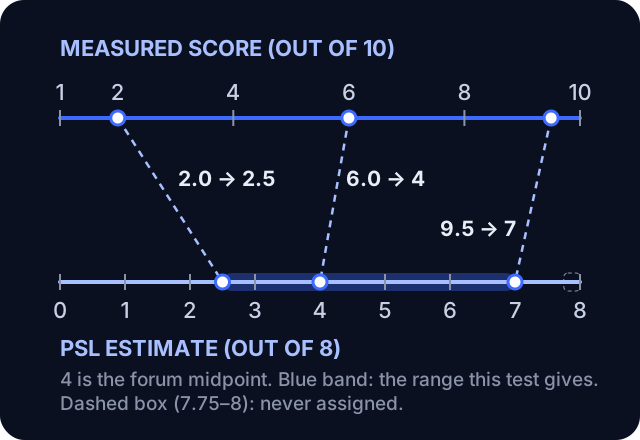
The conversion has three anchor points. The engine is tuned so that a typical face lands near 6.0 out of 10, so 6.0 becomes PSL 4, the forum midpoint. Above the midpoint, each point of measured score adds about 0.86 PSL, up to PSL 7 at 9.5 out of 10. Below the midpoint, the scale is compressed to 0.375 PSL per point, down to 2.5 at 2.0 out of 10. For example, a measured 7.5 becomes 5.25 (HTN), and a measured 5.0 becomes 3.75 (MTN).
Why cap the result at 7? Forums reserve the top of the scale for a few famous faces, and a single front photo cannot measure skin or leanness, which forum raters also judge. Giving someone True Adam from part of the evidence would be false precision. The same logic applies to the floor.
What the test measures, pillar by pillar
| Forum pillar | What we measure | Status |
|---|---|---|
| Harmony | How close your proportions are to typical ranges, where your eyes, nose and mouth sit, and left–right symmetry | Measured |
| Dimorphism | For men, jaw width relative to the cheeks. For women, nothing yet | Partly measured |
| Angularity | Facial leanness needs an estimate of facial fat, which landmarks cannot separate from bone | Not measured |
| Miscellaneous | Skin, brows, teeth and hair need image analysis, not geometry | Not measured |
Unmeasured pillars are left out of the calculation. They neither raise nor lower your estimate, and the result shows them as "Not measured" rather than guessing. For men, proportions carry about 71% of the measured weight; for women, about 85%. The result lists each pillar's share.
What your PSL estimate means
Your result has four parts:
- The estimate and tier. For example, 5.25 and high-tier normie. Do not read much into a single quarter point: another photo of the same face can change the measurements.
- The measured score. The number out of 10 that the estimate came from, so you can check the conversion yourself.
- The measured areas. Harmony, feature placement, symmetry, jaw width (men) and canthal tilt, each colored strong, typical or below typical.
- Your biggest opportunity. The measured area that falls furthest below typical in its unfavorable direction, with what actually changes how that area reads. If nothing measured is below typical, the result says so and names the least strong area, or points you to the pillars a photo cannot measure. If your head was turned in the photo, the test will not send you to fix symmetry, because a turned head exaggerates asymmetry.
Which direction counts as better
A weakness depends on direction, not only on distance from average. The test treats each measured area this way:
- Harmony: closer to typical proportions is better, in line with the averageness research below.
- Symmetry and feature placement: higher is better.
- Canthal tilt: a more positive tilt is never marked as a weakness. Only a tilt below the typical range is.
- Jaw width (men): a jaw wider than typical relative to the cheeks is a sex-typical male trait, and forums count it as a strength, so it is never called a weakness. Only a clearly narrower jaw is. The engine's small dimorphism part, 5% of the male rating, still scores closeness to the typical range, so a very wide jaw lowers the measured score a little. The result tells you when that happens and by how much.
- Women: there is no validated femininity measure yet, so jaw width is not judged at all.
These scores are app estimates of photo geometry. They are not an objective measure of your worth, your attractiveness to any particular person, or a medical finding.
It also helps to know what raters in research actually agree on. A meta-analysis by Langlois and colleagues found that people agree about who is attractive, within and across cultures. Rhodes's 2006 review found that averageness, symmetry and sexual dimorphism are attractive in both male and female faces and across cultures. The engine's formula is built on these factors, with averageness weighted most. None of this research validates the PSL tiers, which are forum conventions.
How accurate is a PSL test?
A PSL test is only as good as the photo and the scale behind it. Five limits matter most.
One photo is one version of your face. In a study of photos of the same people, Jenkins and colleagues found that attractiveness varied more between photos of the same person than between different people. Your PSL estimate describes this photo.
Lens distance changes proportions. A Rutgers and Stanford model, published in JAMA Facial Plastic Surgery, showed that a selfie taken about 12 inches from the face makes the nasal base look about 30% wider than a photo from 5 feet. Arm's length or farther gives truer ratios.
Pose moves the numbers. The engine corrects head roll, but a turned head changes left–right distances. The test warns you when your head is turned, and rejects side views.
Expression and light matter. A smile moves the mouth corners and lip ratios. Harsh side light can hide landmarks at the jaw and brows.
The scale itself is unvalidated. Even a perfect measurement lands on a scale that forum users invented and do not apply consistently. Our conversion is transparent, but it is still a translation into an informal system.
What can change and what cannot
The pillars the test measures are mostly about bone-driven proportions: eye spacing, nose width relative to the eyes, jaw width relative to the cheeks, and where features sit. Skincare, grooming or exercise routines do not change adult bone proportions, so your measured harmony score will mostly move only with photo conditions.
The pillars the test does not measure are the ones that change most:
- Facial leanness. In a 2009 study by Coetzee, Perrett and Stephen, perceived facial adiposity, the look of weight in the face, predicted how healthy and attractive faces were rated. A 2018 review describes mounting evidence of a robust link between facial adiposity and attractiveness. Forum "angularity" is largely this.
- Skin. In an eye-tracking study of female faces, faces with more even skin tone were judged younger and more attractive. In lighter skin, uneven color builds up with age mainly through sun exposure, as Fink and colleagues summarize.
- Grooming and hair. Brow shape, haircut and facial hair change how the eye area and jawline read, even when the landmarks do not move.
- Photo habits. Distance, light and head position change the measured numbers themselves.
For the unmeasured pillars, see what softmaxxing can and cannot change, with a week-by-week plan.
Be careful with advice that treats a PSL number as a reason for surgery or unproven hacks. A rating from one photo on an informal scale is not a treatment plan. Talk to a qualified professional about medical or cosmetic decisions.
How to take a photo for a fair result
Use the same setup each time so you can compare results. Our full guide to taking photos for face analysis covers it in detail. The short version:
- Hold the camera at eye level and at least at arm's length, or use a timer and a shelf.
- Face the camera straight on with your head level.
- Keep a neutral expression with your mouth closed.
- Use soft, even light from the front, such as a window.
- Pull hair off your forehead and brows, and remove glasses.
If two photos give different tiers, trust the one taken in better conditions, not the higher number.
Related face tools
Each PSL pillar has its own tool with more detail:
- The attractiveness test rates your face on a 1–10 scale from the same measurement engine.
- The face symmetry test compares your left and right sides region by region.
- The canthal tilt test measures the eye-corner angle that PSL forums discuss constantly.
- The golden ratio face calculator compares your ratios with 1.618 and with research-based proportions.
- The face shape detector classifies your face as oval, round, square, heart or oblong.
Frequently asked questions
What is the PSL scale?
The PSL scale is a 0–8 face rating from looksmaxxing forums. Raters give a number, often in quarter or half points, and attach a named tier such as mid-tier normie or Chadlite. Forum raters say they judge harmony, dimorphism, angularity and features such as skin. There is no official body or scoring manual, so every rater and app applies it a little differently.
What does PSL stand for?
PSL comes from the names of three looksmaxxing forums: PUAHate, SlutHate and Lookism. Users of those forums built the rating system in the 2010s, and the name stayed with it after the forums closed. Today PSL simply means that 0–8 face rating scale, which spread from the forums to TikTok and everyday slang.
What is an average PSL score?
Forum guides treat 4 as the midpoint of the scale, and most people are described as some tier of normie around it. That midpoint is a community convention, not a measured population average. On this test, a typical measured face lands at about 4.
What is a good PSL score?
By forum convention, 5 to 5.75 (high-tier normie) is clearly above the midpoint, and 6 or more (Chadlite or Stacylite) is used for model-like faces. No dataset validates these labels, and the same face can land a tier apart in two different photos.
What do LTN, MTN and HTN mean?
They are the three normie tiers: low-tier, mid-tier and high-tier normie. On this test, LTN covers 3 to 3.5, MTN covers 3.75 to 4.75 and HTN covers 5 to 5.75. MTN is the middle of the scale, where forum guides place most people. HTN is clearly above the midpoint and is often called good-looking in everyday life.
What is a Chadlite on the PSL scale?
Chadlite is the forum tier just below Chad, from 6 to 6.75 on this test, and forum guides use it for model and actor faces. Chad, from 7 to 7.5, is kept for a small number of famous faces, and 7.0 is the highest estimate this test gives. True Adam, above 7.75, is a theoretical ceiling that this test never assigns.
Does the PSL scale work for women?
Yes. Forums use the same 0–8 numbers for women, with Stacylite and Stacy in place of Chadlite and Chad. This test uses the normie tier names for everyone and compares your face with women's reference ranges when you choose them. There is no validated front-photo measure of femininity yet, so that part shows as not measured and never counts against you.
Is the PSL scale scientific?
No. It is an informal forum scale with no validated scoring method, and researchers describe it as pseudoscientific. Some of what it rates, such as averageness, symmetry and sex-typical features, is linked to attractiveness in research, but the tiers, cut-offs and labels are forum inventions.
Is a PSL rating accurate?
Only partly. The measurements behind this estimate are repeatable for the same photo, but a different photo of the same face can move the result by a tier, and the scale itself has no validated cut-offs. The test also cannot see skin or facial leanness. Read the estimate as a description of this photo's geometry, not a fixed verdict on your face.
How is the PSL scale different from a 1–10 rating?
PSL runs from 0 to 8 and puts the average near 4, so the same face gets a lower-looking number than on a casual 1–10 scale. There is no official conversion. This test publishes its own: a measured 6.0 out of 10 becomes PSL 4, and 9.5 or more becomes PSL 7.
Is this PSL scale test free?
Yes. The test on this page is free, needs no account and shows the full result: your PSL estimate, tier, measured score and every measured area. It runs in your browser, so you can retake it as often as you like and compare photos taken at a better distance or in better light.
How do I find my PSL score?
Take or upload a front photo in the test at the top of this page and choose men's or women's reference ranges. The test places 478 landmarks on your face, measures proportions, symmetry, eye tilt and jaw width, and converts the measured score to a PSL estimate with a published formula. Use a straight-on photo at arm's length or farther, in soft front light.
Can AI or ChatGPT give me a PSL rating?
A chatbot can give you a PSL number from a photo, but it does not show how it got there, and asking again can give a different answer. This test uses a face landmark model and fixed formulas instead, so the same photo gives the same estimate, and every step from measurement to PSL number is published on this page.
Is it safe to take a PSL test?
On this test, your photo is processed in your browser and is never uploaded. The bigger risk is how you use the number. PSL is a harsh, informal scale, and one photo can move you a tier. If a rating makes you anxious or pushes you toward surgery or unproven hacks, step back and talk to someone you trust or a qualified professional.
Can you raise your PSL score?
You cannot change adult bone proportions with a routine, and this test measures mostly those. You can change how your face reads: facial fat, skin, brows, hair, facial hair and how you take photos all affect how people rate a face. The forum pillars for leanness and skin are exactly the parts a landmark scan does not measure.
Why is my PSL score lower than I expected?
The PSL scale is harsher than everyday ratings on purpose, so an ordinary face sits around 4. Your photo also matters: a close camera, a tilted head, a smile or uneven light can move the measurements. Retake the photo with the camera at arm's length, at eye level, and compare.