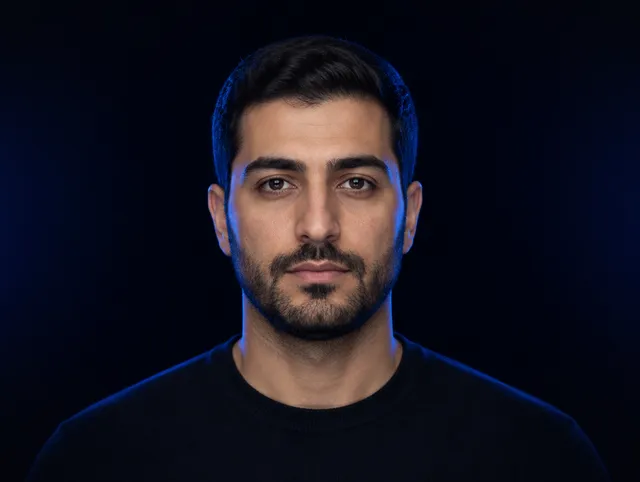
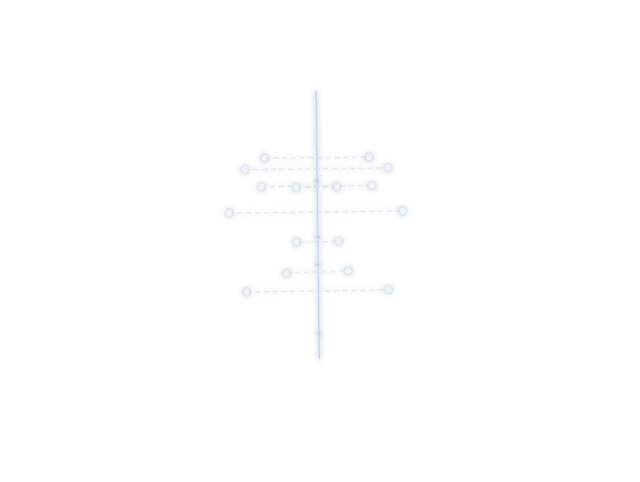
A face symmetry test measures how closely the left and right sides of your face mirror each other. This one finds 478 landmarks on your photo, fits the line your face is most symmetric about and folds your face along it. You get an overall score, an estimate in millimetres for six regions, the side and direction of each difference, and two mirrored faces built from your own photo.
The photo is processed only in your browser and is never uploaded or saved. The score is an app estimate from one photo, not a measure of your worth and not a medical assessment.
What the face symmetry test measures
A simple symmetry check draws a vertical line through the middle of the photo, or through two points such as the forehead and the chin. That can make a crooked chin look like crooked eyes, because the whole line tilts with it.
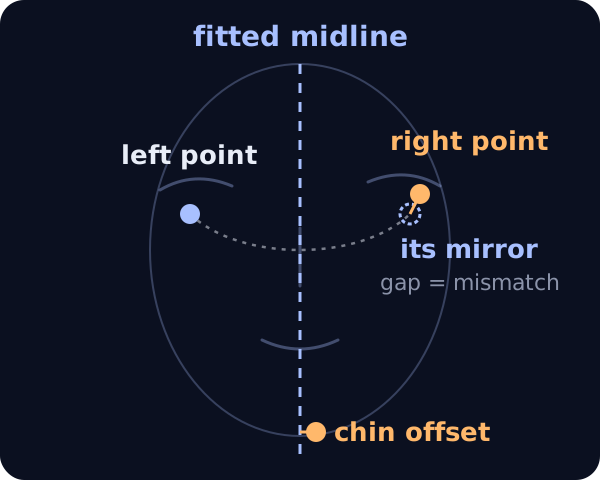
This test fits the midline first. It mirrors the upper and central face (brows, eyes, nose and mouth, plus the points along your forehead and nose bridge) and finds the line that makes the mirror image match your real face best. This is a 2D version of the Procrustes method researchers use to separate symmetric shape from asymmetry (Klingenberg et al., 2002). Your jaw, chin and cheek outline do not steer the line, so they are measured against it instead of moving it.
Then it compares about 70 mirror pairs of landmarks in six regions:
| Region | What is compared |
|---|---|
| Brows | Height and spread of 10 points along each brow |
| Eyes | Corners, lids and pupils: height, distance from the midline and how wide each eye opens |
| Nose | Nostril and nose-side points, and how far the tip sits from the midline |
| Mouth | Corner height, lip outline points and the mouth center |
| Cheeks | Width of each side at cheekbone level |
| Jaw & chin | Jaw outline on each side and how far the chin sits from the midline |
Each left point is mirrored across the midline and compared with its partner on the right. The gap between them is the mismatch. Pixel distances become millimetres through the average adult pupil distance of about 63 mm (Dodgson, 2004). Most adults fall between 50 and 75 mm, so treat the millimetres as estimates within about 20%.
Sides are named as they appear in the photo: photo-left and photo-right. Many phones save selfies mirrored, so "your left" could mean either side. If the photo is not mirrored, your right side is the photo-left.
How to read your symmetry score
Each region's score starts at 100 and loses 5 points for every millimetre of average mismatch. The overall score is the average of the six regions. The bands come from perception research: in a clinical review, differences smaller than about 3 to 4 mm, and tilts under 3 to 4 degrees, are generally not seen as asymmetry (Choi, 2015). When 10 orthodontists sorted 100 frontal photos into needs treatment or not, their dividing line averaged a chin offset of 4.28 mm, measured on X-rays (Masuoka et al., 2007).
| Score | Average mismatch | What it means |
|---|---|---|
| 93–100 | Under 1.5 mm | Very close to a mirror. Part of what remains is landmark noise. |
| 85–92 | 1.5 to 3 mm | Small differences that people rarely notice. |
| Under 85 | Over 3 mm | At least one region differs by an amount people can notice, or the photo was taken at an angle. |
Read the region rows before the total. One region often explains most of a lower score, and its row tells you which side and which direction. The fold map under your result draws every mirror pair on your photo, colored by how closely each region matches, so you can see where the gaps are.
The "biggest opportunity" card comes from the same rows. It names the region that falls furthest short: the largest average mismatch, when that mismatch is 1.5 mm or more. The title is the measured finding, such as "Photo-left brow sits 1.8 mm higher". The card then says what can change there (brow grooming, expression, photo setup) and what cannot (bone position). If every region is under 1.5 mm, the card says so and names your least-matched region without calling it a flaw. With a turned head, it looks only at the brows, eyes, nose and mouth, because pose distorts the cheek and jaw rows most.
How symmetrical are real faces?
No face is a perfect mirror. In a 3D study of 191 people aged from infancy to 88, the average surface deviation from perfect symmetry clustered between 0.4 and 1.3 mm, and asymmetry increased with age in every third of the face, most in the lower two-thirds (Linden et al., 2018). In a Finnish cohort of 748 adults, women's faces were more symmetric than men's (Heikkinen et al., 2024).
The differences also follow patterns. Among 1,800 orthodontic patients photographed from the front, 79.7% of those with an asymmetric face had a wider right side, and 79.3% of chin deviations pointed to the left. The authors concluded this sidedness is more likely inherited than acquired (Haraguchi et al., 2008). A 3D study of 163 healthy people found a consistent pattern too: the forehead, nose, lips and chin protrude slightly more on the right, in both sexes (Harnádková et al., 2024).
When asymmetry is large enough to see, it is usually in the lower face. In 1,460 patients at a university clinic for jaw and face deformities, 34% had clinically visible asymmetry. Of those, 74% involved the chin, 36% the midface (mostly the nose) and only 5% the upper face (Severt and Proffit, 1997). That group had jaw problems, so these numbers describe patients, not everyone.
Does facial symmetry matter for attractiveness?
It matters, but less than its reputation. In experiments, making a face more symmetric raised its attractiveness ratings, and natural symmetry correlated with ratings (Rhodes et al., 1998). A review with meta-analyses found that averageness, symmetry and sexual dimorphism are all attractive in male and female faces and across cultures (Rhodes, 2006).
The size of the effect is the catch. A meta-analysis of asymmetry and attractiveness found substantial publication bias: correcting for it cut effect sizes by 30 to 50%, and in the few studies with more than 100 participants, the effect was nearly zero (Van Dongen, 2011). Other experiments point the other way. Faces made more symmetric with a method that kept feature size the same were rated less attractive (Swaddle and Cuthill, 1995), and observers preferred natural, slightly asymmetric faces over perfectly symmetric composites when the faces showed emotion (Kowner, 1996).
Symmetry is also a weaker health signal than often claimed. In 4,732 British teenagers, facial asymmetry measured from 3D scans was not linked to their childhood health records (Pound et al., 2014). For how symmetry fits with the other factors, see the attractiveness test, where symmetry is one weighted part of the score, and the PSL scale test.
Why is my face asymmetrical?
Usually for several small reasons at once, and many of them start early.
- Development and inheritance. The consistent right-wider, chin-left pattern in large samples points to inherited sidedness (Haraguchi et al., 2008). In a Finnish birth cohort, asymmetry decreased between ages 1 and 6, and a flattened head in infancy and sleeping position were among the possible predisposing factors at age 6 (Launonen et al., 2023).
- Jaw and teeth. Most visible asymmetry sits at the chin (Severt and Proffit, 1997). In adults with an underbite, those with jaw-joint symptoms, past facial trauma or condyle changes had larger chin deviations (Haraguchi et al., 2002).
- Chewing side. The evidence is mixed. In 748 Finnish adults, a preferred chewing side had no significant effect on facial asymmetry; missing teeth made people favor one side (Heikkinen et al., 2024). In a smaller study, right-side chewers had a slightly protruding right side, a link found only in men, and the design cannot show which came first (Harnádková et al., 2024).
- Sleeping on one side. We found no study showing that an adult's sleeping side reshapes facial symmetry. The research covers infants' head shape and the creases that pressure on the pillow causes over time (Anson et al., 2016).
- Aging. Asymmetry increases with age, most in the lower two-thirds of the face, probably through uneven bone remodeling and soft-tissue descent (Linden et al., 2018).
- Expression. The two sides do not move equally. Composites built from two left halves of posed expressions look more emotional than those built from two right halves (Sackeim et al., 1978). A smile or a raised brow shows up directly in the mouth and brow rows.
When facial asymmetry needs a doctor
If one side of the face suddenly droops, call emergency services straight away: a face droop is one of the main warning signs of stroke (CDC). Weakness on one side that develops over a few days can be Bell's palsy, which also needs a doctor (NHS). See a doctor or dentist too if a difference is new, getting worse, painful, or affects chewing, speech or closing an eye. This test measures a still photo and cannot tell any of these apart.
Why your face can look asymmetrical in photos
Many "asymmetric" results come from the photo, not the face. The test corrects head tilt, but other conditions still change the numbers:
| Photo condition | What it does | Fix |
|---|---|---|
| Head turned slightly | The near side looks wider; cheek and jaw rows suffer most | Face the lens straight on |
| Phone close to the face | Features nearest the lens look bigger; a selfie at about 30 cm makes the nose look about 30% wider than at 1.5 m (Ward et al., 2018) | Hold the camera at arm's length or farther, at eye level |
| Light from one side | Shadows move the detected edges on the dark side | Face a window or soft, even light |
| Smile or raised brow | Moves the mouth corners and brows unevenly | Neutral face, lips closed |
| Hair over one side | Hides brow, cheek and jaw edges, so their landmarks are guessed | Clear hair off your face |
Familiarity plays a part too. People preferred their own mirror image while their close friends preferred the true, unmirrored image (Mita et al., 1977). A photo shows every difference on the side you do not expect, so it looks more lopsided to you than to anyone else. For a step-by-step setup, see how to take photos for face analysis.
Your mirrored faces: what the fold shows
Under your result, the test builds two faces from your photo. Left × 2 joins your photo-left half to its mirror image, and Right × 2 does the same with the photo-right half. Both are cut along your fitted midline, not the center of the frame, so an off-center selfie does not distort them. You can save all three side by side as one image.
Mirroring doubles whatever one side carries, so the two faces often look like relatives: one broader, one narrower, one with a higher brow. The size of that difference is your asymmetry made visible. Neither face is the "real" you or the better one. Researchers have used these composites for decades, and even with faces from modeling agencies, observers usually picked one of the left-left and right-right versions as more attractive instead of calling them equal (Zaidel and Cohen, 2005).
What can and cannot change
Bone position does not change with a routine. Marked jaw or chin asymmetry that affects your bite or function is treated by orthodontists and surgeons, and the thresholds above are the kind they use to decide.
Some things are under your control. Brows can be shaped and filled toward each other. Hair parting, beard shape and grooming can change how much attention the outline of the jaw and cheeks gets. Expression habits, such as raising one brow or smiling to one side, change how your face reads at rest and on camera. For tracking, use the same camera, distance, light and expression every time, so that a change in the score reflects your face and not the setup.
Other measurements worth checking
Symmetry is one part of a face. The golden ratio face calculator compares your proportions with 1.618 and with research-based ranges. The face shape detector measures your face widths and length. The canthal tilt test measures the angle of each eye separately, which helps if your eye row shows one eye sitting higher.
Frequently asked questions
Is my face symmetrical?
Not perfectly, and nobody's is. In a 3D study of 191 people, the average surface difference between the two sides was 0.4 to 1.3 mm for most faces. What matters is how large your differences are and where they sit. This test measures six regions in estimated millimetres and names the side and direction of the largest difference in each, so you see more than a yes or no.
How can I tell if my face is symmetrical?
Take a straight-on photo in even light with a neutral face, then compare the two sides against a midline. This test does that with 478 landmarks: it fits your midline, mirrors each point on one side onto the other and measures the gap in estimated millimetres for your brows, eyes, nose, mouth, cheeks and jaw.
What is a good face symmetry score?
On this test, 93 or more means your two sides differ by less than about 1.5 mm on average, which is very close to a mirror. 85 to 92 means small differences that people rarely notice. Below 85 means at least one region differs by 3 mm or more, or the photo was taken at an angle. Retake a low result before you trust it.
Is it normal to have an asymmetrical face?
Yes. Every face has some asymmetry. In a 3D study of 191 people, even the most symmetric faces were not perfect mirrors, and asymmetry grew with age. Most differences are a few millimetres or less, which is under the size people usually notice.
Does anyone have a perfectly symmetrical face?
No measured face is a perfect mirror. Small differences in bone, soft tissue and how each side moves are normal, and they increase with age. Perfect symmetry is not the ideal either: when faces showed emotion, observers preferred the natural, slightly asymmetric originals over perfectly symmetric composites. A score near 100 on this test means the measured points match within landmark noise, not that the two sides are identical.
Why does my face look more asymmetrical in photos than in the mirror?
You are used to your mirror image, so a photo shows every difference on the side you do not expect. In a classic study, people preferred their own mirror image while their friends preferred the true image. A phone held close to the face and a slight head turn also exaggerate differences.
Why does my face look uneven on camera?
Often it is the camera, not your face. A front camera held close makes the nearest features look bigger: a selfie at about 30 cm makes the nose look about 30% wider than a photo from 1.5 m. A slight head turn makes the near side look wider, and light from one side moves the edges the camera sees. Use the back camera at arm's length or farther, at eye level, facing even light.
Does facial symmetry make you more attractive?
A little. Experiments that make faces more symmetric often raise ratings, but a meta-analysis found publication bias in this research: after correction, effect sizes fell by 30 to 50%, and in the larger studies they were close to zero. Averageness, skin, expression and grooming matter too.
Which side of the face is usually bigger?
In a study of 1,800 orthodontic patients photographed from the front, 79.7% of those with an asymmetric face had a wider right side, and most chin deviations pointed to the left. In an unmirrored photo, the person's right side appears on the photo-left.
Why is my face not symmetrical anymore?
Slow change is normal: asymmetry increases with age, most in the lower two-thirds of the face, probably through uneven bone remodeling and soft tissue that descends over time. A change you notice over hours or days is different. A face that suddenly droops on one side is a stroke warning sign, so call emergency services. Weakness that develops over a few days can be Bell's palsy and also needs a doctor.
Can you fix an asymmetrical face?
Differences in bone and jaw position change only with orthodontic or surgical treatment, which specialists consider when asymmetry is marked or affects function. Brows, hair, beard and how you hold your face in photos are the parts you control directly. Your result names the region that falls furthest short and what can and cannot change there.
How accurate is an online face symmetry test?
It depends on the photo more than on the software. This test has no clinical validation, so it gives no accuracy figure. Its millimetres are scaled from an average 63 mm pupil distance, and most adults fall between 50 and 75 mm, so read them as estimates within about 20%. A turned head, a close camera, uneven light or an expression change the result, so compare photos taken the same way.
Is this face symmetry test free and private?
Yes. The test is free, needs no account and runs in your phone or computer browser, so you do not need to install an app. Your photo is analyzed on your device and is not uploaded. If you create a share link, only the result card is stored, for 30 days, and it shows your face only if you choose that.
What is the face symmetry mirror test?
It joins each half of your face to its own mirror image, so you get one face made from two left halves and one from two right halves. This test cuts both along your fitted midline, not the center of the photo. The two faces often look like relatives because mirroring doubles what each side carries. Neither is the real or better you; the gap between them is your asymmetry made visible.
Why is my smile crooked?
The two sides of the face do not move equally. In a classic study, faces built from two left halves of posed expressions looked more intense than faces built from two right halves. Teeth, head angle and the moment the photo is taken also change how even a smile looks. This test reads your resting face, so use a neutral expression with lips closed. A smile that suddenly becomes uneven is a stroke warning sign.
Why is one eye lower than the other?
Small differences in eye height are common and are mostly set by bone. In a photo, a tilted head can make one eye look much lower than it is. This test fits your midline first and removes head tilt, then shows any height difference that remains in the eye row, in millimetres, with the side named. Brow shape changes how level the eye area reads; the bone position does not change with routines.
Does sleeping on one side make your face asymmetrical?
We found no study showing that an adult's sleeping side changes facial symmetry. The research on sleep and faces covers infants, whose head shape and sleeping position were among possible factors in early asymmetry, and the creases that pillow pressure causes in adult skin over time. Changing the side you sleep on is not a proven way to even out your face.
Does chewing on one side cause facial asymmetry?
The evidence is mixed. In 748 Finnish adults, a preferred chewing side had no significant effect on facial asymmetry, and missing teeth made people favor one side. A smaller study found a slightly protruding right side in right-side chewers, only in men, and could not show which came first. If you chew on one side because of pain or missing teeth, see a dentist.