LooksLab guide
Beard Styles for Face Shape: Round, Square, Oval, Long
Which beard suits your face shape: round, oval, square, long, heart or diamond, plus weak chin, double chin and patchy growth, with a 6-week test.
For a round face, keep the sides short and let the chin grow longer; for a long face, keep the chin short and the sides fuller. Heart and diamond faces suit fullness at the jaw and chin, a square face can show its jaw with crisp edges or soften it with a rounder beard, and an oval face suits most lengths.
These are barber conventions, not research results: no study has tested which named beard suits which face shape. If you do not know your shape, you can measure your face shape from a photo with our free detector; how to read the result comes straight after the table. If your beard is patchy or your chin is the concern, the sections further down matter as much as the shape.
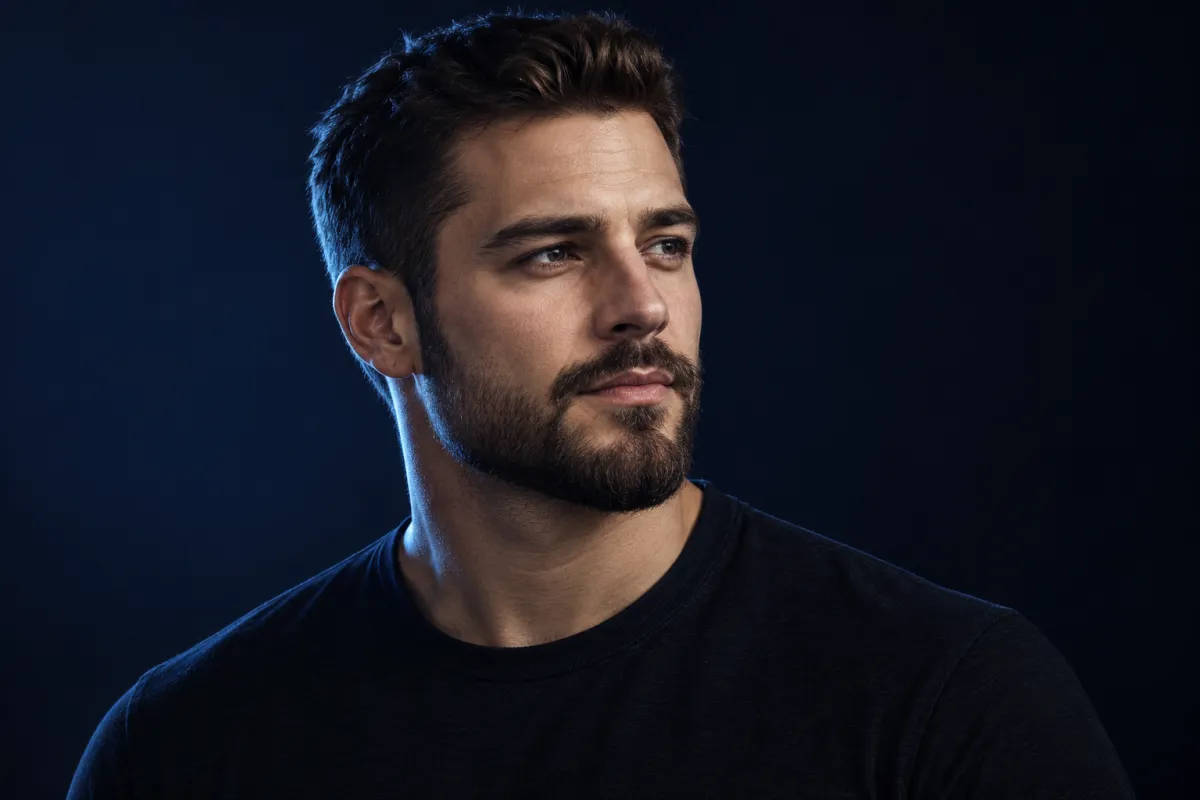
Which beard style suits my face shape?
The table sums up that barber advice. The last column quotes the styling note our face shape detector gives for each shape.
| Shape | Goal | Styles to try | Go easy on | Detector's note |
|---|---|---|---|---|
| Round | Add length, keep width down | Short boxed beard with a longer chin, Van Dyke, extended goatee | Beard bulk on the cheeks; long sideburns | "Beards that are longer at the chin and short at the sides lengthen the face." |
| Oval | Keep the balance | Anything from heavy stubble to a full beard; keep a moustache | Little to avoid; if your result leans oblong, a long chin | "Any beard length works." |
| Square | Show the jaw, or soften it | Show: stubble or a short boxed beard with crisp edges. Soften: a full beard with a rounded bottom | A sharp, flat bottom line if you want to soften | "Crisp beard edges along the jaw keep it defined; length at the chin adds length." |
| Oblong / long | Add width, not length | Short boxed beard with full sides, cheek-heavy full beard | Long chin, goatee on its own, tapered sideburns | "Fuller beard sides with a short chin keep the proportions even." |
| Heart | Add width low down | Short to medium full beard, boxed beard | A narrow, pointed chin beard | "A fuller beard at the chin and jaw adds width low down." |
| Diamond | Fill the chin and jaw | Full beard, boxed beard with a full chin | Bulk high on the cheeks | "A beard that fills the chin and jaw frames wide cheekbones." |
How do I know my face shape?
Our free face shape detector measures a front photo in your browser and matches it to six profiles. It compares four measurements with the width across your cheekbones: length (upper forehead to chin, since the mesh cannot see your hairline), forehead width at the temples, jaw width at the jaw corners, and chin width, which is measured against jaw width instead. These are the profiles, rounded:
| Shape | Length ÷ cheek width | Forehead (% of cheek width) | Jaw (% of cheek width) | Chin (% of jaw width) |
|---|---|---|---|---|
| Oval | 1.20 | 93% | 78% | 69% |
| Round | 1.07 | 92% | 79% | 72% |
| Square | 1.10 | 95% | 85% | 75% |
| Heart | 1.17 | 96% | 74% | 65% |
| Diamond | 1.19 | 88% | 75% | 66% |
| Oblong | 1.29 | 94% | 82% | 72% |
The values are targets set in the tool, not averages of real faces, and they have not been checked against faces labelled by people. The detector has no single cutoff for any shape: all four measurements count toward every match, and you get the profile you sit closest to. The table shows why three pairs get confused:
- Round or oval? The jaw is almost the same width (79% vs 78%); length separates them (1.07 vs 1.20).
- Square or oblong? Both have the widest jaws of the six (85% and 82%); again length separates them (1.10 vs 1.29), which is why their beard advice differs.
- Heart or diamond? Both narrow toward the jaw (74% and 75%). A heart face has the widest forehead of the six (96% of cheek width) above the narrowest chin; a diamond face has the narrowest forehead (88%), so the cheekbones stand out. Both get the same beard goal: fill the jaw and chin.
As a rough illustration, the detector's page notes that with the widths at typical values, a length ratio below about 1.14 reads round and above about 1.26 reads oblong. Treat those as examples, not cutoffs.
The result comes with a badge. Clear means the top shape has at least 55% of the share and leads by 30 points or more. Blend means the top two are less than 12 points apart, so use the advice for both. Anything in between is leaning: the leader's advice fits best, and some of the runner-up's fits too. The percentages are how closely you fit each profile, not the chance a barber would agree. Results from this and our other tools are estimates from one photo.
A beard moves the outline. The detector fits its outline to what it sees, and its own notes warn that a full beard can widen the lower face. So scan clean-shaven or with short stubble to read your frame; a second scan with the beard, in the same photo setup, gives a rough idea of how the beard changes it. It cannot measure beard density or simulate a style.
Beard styles for each face shape
Beard for a round face
Let the chin run a little longer than the sides, so the bottom of the beard looks squared or slightly pointed rather than round, and set the cheek line low so less beard sits on the widest part of the face. A full beard can work on a round face if the cheeks stay short and close.
A goatee for a round face has to cover enough of the lower face. On full cheeks a small goatee can look undersized; a Van Dyke or an extended goatee covers more of the jaw.
Beard styles for an oval face
With an oval face the shape rarely limits you, so choose by coverage and upkeep: the patchy-beard table and the 6-week test below matter more than the shape. Heavy stubble, a short boxed beard and a full beard all suit the proportions, so start with the one you can keep tidy, and keep a moustache with it.
Beard for a square face
Barber advice splits on square faces. To show the jaw, keep stubble or a short boxed beard with crisp lines along the jaw and cheeks. To soften it, grow a full beard or a classic short beard with a little extra chin length, and round off the bottom corners. Neither is more correct: decide whether you like your jaw corners or want them less prominent.
Beard for a long or oblong face
Keep the sideburns and cheeks fuller than the chin and square off the bottom close to the jaw; a long goatee or a beard that tapers to a point adds length. Leave the sideburns full too rather than tapering them, since the goal is width at the sides.
Beard for a heart-shaped face
In the detector's profiles, a heart face has the narrowest chin of the six under the widest forehead. A full or boxed beard of short to medium length adds width at the bottom; a narrow, pointed chin beard repeats the taper.
Beard for a diamond face
Fill the chin and jaw so the lower face matches the cheekbones, and keep the cheeks close so the beard does not add width at the widest point.
What beard suits a weak chin?
Check the chin in a side photo with your head level: a receding chin shows in profile, which the detector's front photo cannot see.
If it does sit back, the usual barber advice is to grow more length at the chin and keep the sides shorter, so the bottom of the beard sits further forward in profile: a short boxed beard with a longer chin, a Van Dyke or a goatee. If a full beard will not grow, use the chin-and-moustache styles in the patchy-beard table below.
Beard for a chubby face or double chin: where should the neckline go?
A beard changes how the lower face is framed; it does not remove fat. For a chubby face, follow the round-face advice. If fullness is the bigger issue, our guide to face fat covers how much weight it takes to change your face.
The neckline does most of the work. A common barber convention places it in a soft curve about one to two finger widths above the Adam's apple, marked with your head level before you tilt it up to trim (GQ). It is a starting point, not an anatomical rule.
The double-chin adjustment is common grooming advice, not part of that source. The usual mistake is a line pushed up to the jawbone, which leaves the soft area underneath showing below the beard. The usual fix is to keep the line at the finger-width height or slightly lower, check it from the side, and let the beard cover the area under the jaw.
What beard style works if my beard is patchy?
Beard density is partly genetic. In a genome-wide study of more than 6,000 Latin Americans, beard thickness was linked to gene variants, including a region overlapping the EDAR gene (Adhikari et al., 2016). Androgens drive beard growth, but the response is specific to the hair follicle itself (Randall, 2008), so patchy cheeks on their own are not a sign of low testosterone.
Letting hairs grow longer makes them longer; it does not add follicles where there are none. So build the style around where you grow:
| Your coverage | Styles that work with it |
|---|---|
| Thick chin and moustache, sparse cheeks | Goatee, Van Dyke, or a Balbo (moustache and chin beard without sideburns) |
| Thick chin and jaw, sparse cheeks | Short boxed beard with the cheek line set low, or a chin-heavy beard with trimmed sides |
| Sparse chin, fuller cheeks | Even heavy stubble, or a short full beard with the chin no longer than the sides |
| Thin all over | Heavy stubble kept short and even, so the gaps show less contrast |
Combine this with your shape: on a round face with sparse cheeks, a Van Dyke covers both problems; on a long face with sparse cheeks, keep everything short and even rather than growing chin length.
A new, smooth bald patch (often round or oval) is different from cheeks that have always been sparse. Alopecia areata can start in the beard (AAD), so a patch that appears suddenly needs a dermatologist, not a new style.
A note on minoxidil. The evidence for beards is one small trial: 46 of 48 men completed 16 weeks of 3% minoxidil lotion or placebo on the chin and jaw line. The minoxidil group had better photo ratings and hair counts, but hair diameter (how thick each hair is) did not differ, and side effects were mild, with no significant difference between the groups (Ingprasert et al., 2016). The trial ran 16 weeks and does not tell us about longer use. Over-the-counter minoxidil is labelled for the scalp; one such label, for a minoxidil foam, says to use it to regrow hair on the top of the scalp and not to apply it to other parts of the body (DailyMed). Using it on a beard is off-label, so ask a doctor before trying it.
Does a beard make you more attractive?
In one large online experiment, 1,666 people, mostly women, rated photos of 36 men of European descent. On average, light stubble, heavy stubble and full beards were all rated more attractive than clean-shaven faces, and heavy stubble was rated above full beards. Context moved the ratings too: beards scored higher when they were rare among the faces shown just before, and clean-shaven faces gained when they were rare, but clean-shaven faces stayed lowest in every condition (Janif et al., 2014).
A second paper found that full beards, in photos of 37 men, raised ratings of masculinity and dominance, with a smaller effect on attractiveness. In its second study, with composite faces, bearded faces with smaller jaws were rated most attractive and clean-shaven faces with smaller jaws least, with the larger-jaw faces in between (Dixson et al., 2017).
Beards also change how the face itself is read: people recognized anger faster and more accurately in bearded faces, and the authors suggest beards may alter perceived facial structure (Craig et al., 2019). None of these studies compared named styles such as a boxed beard or a Van Dyke.
Our attractiveness test scores facial proportions from landmarks. It does not rate which beard suits you, so use your own photo comparisons for that.
How long should I grow my beard before choosing a style?
Our suggestion, not a rule from any study, is to judge a first shape at 4 to 6 weeks: long enough to see where you grow and to test a shape. A reported average for beard hair is about 0.38 mm a day, and rates vary between people with age, sex, hair colour and ethnicity (ATSDR). In the rarity experiment above, "full beard" meant at least four weeks of untrimmed growth; that describes how the study made its photos, not when a beard looks right.
Take every photo the same way so the comparison is fair: same distance, camera at eye level, same light, head level, neutral face, beard dry. Our guide on how to take photos for face analysis shows a front and side setup you can repeat.
| Week | What to do | Photo checkpoint | Growth at the average rate (yours may differ) |
|---|---|---|---|
| 0 | Shave or trim to even stubble. Run the face shape detector, note your shape and runner-up, and write down your goal from the style table. | Front and side baseline | 0 |
| 1–2 | Do not shape anything yet. For work, tidy only the neck well below where the line will go. | Week 2: map where it fills in: moustache, chin, jaw, cheeks | About 5 mm |
| 3–4 | Set the neckline and a cheek line that follows your coverage. Nothing else. | Week 4: front and side; compare with week 0 | About 11 mm |
| 5–6 | Trim against your goal: shorter sides for round, shorter chin for long, rounder corners if softening a square jaw. | Week 6: front and side, plus a second detector scan with the beard | About 16 mm |
At week 6, put the week 0 and week 6 front photos side by side and look at the outline of the lower face. If it shows the goal you wrote down (longer for a round face, wider at the sides for a long face, crisper or softer corners for a square face, fuller at the jaw for a heart or diamond face), keep the style. If it does not, or your coverage map says the style needs hair you do not grow, switch to the fallback in the patchy-beard table and run another four weeks.
How to shape and look after it
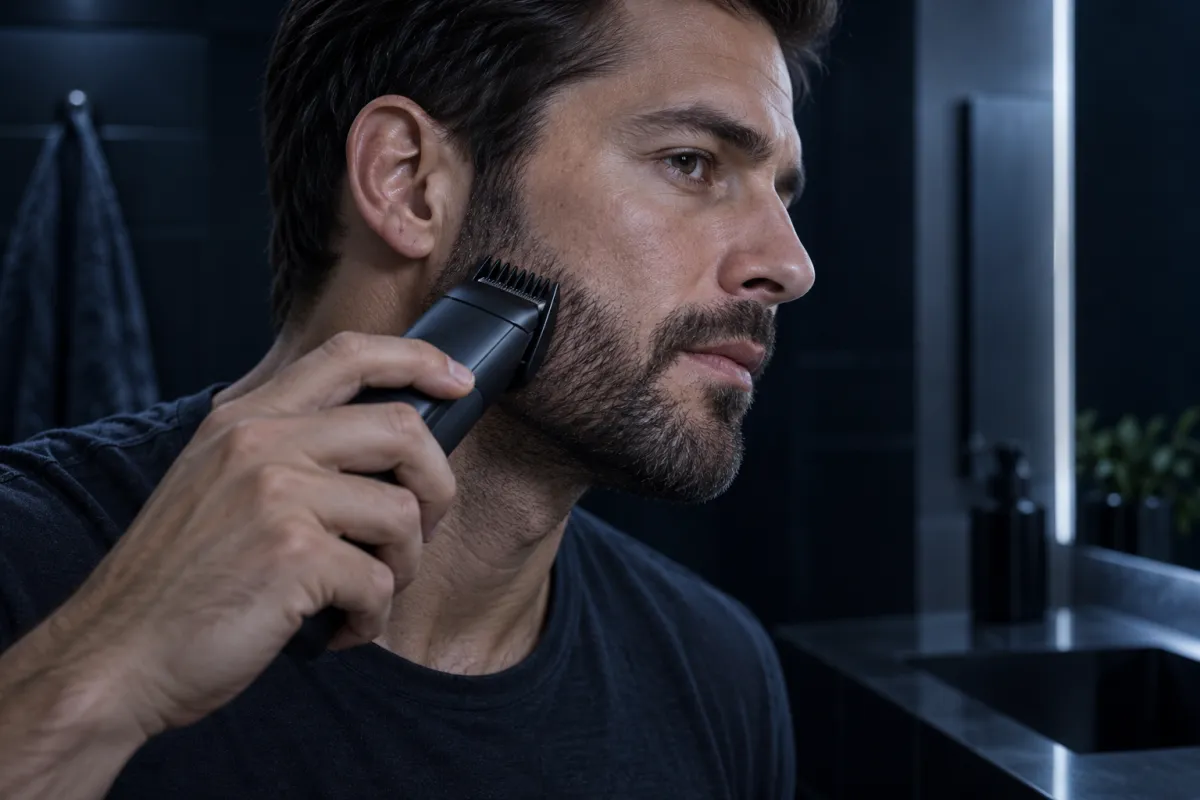
Shape in this order: neckline, cheek line, then length. Use a guard on the trimmer and take off less than you think; you can go shorter but not longer.
Wash your face and beard every day and moisturize for your skin type; for trimming, the AAD suggests applying a shaving oil, cream or gel first and using an electric razor, or scissors once the beard is longer. If you shave the edges, shave in the direction the hair grows and change the blade every 5 to 7 shaves (AAD). Beard oil and balm are care products, not growth treatments.
Razor bumps form when shortened coarse or curly hairs curve back into the skin. Avoid shaving closely, stretching the skin or plucking at bumps. Always apply shaving cream and use a sharp razor; a single-blade razor or an electric razor is often recommended. If you stop shaving, a few new bumps can still appear while the last-shaved hairs grow out (AAD). Growing the beard removes the cause; if you keep shaving the edges, the AAD suggests daily or every 2 to 3 days, so hairs have less time to curl back. Bumps that persist or scar need a dermatologist (AAD).
At the average rate, edges gain about 2.7 mm a week, so the crisper you want the cheek and neck lines, the more often you will need to tidy them.
If one side always looks fuller in photos, first check that your head is not turned. The face symmetry test shows how symmetrical your face is, which helps you tell an uneven trim from an uneven face.
What to tell your barber. Give them five things: your goal (longer, wider or more defined), the areas where you grow well, where your neckline starts (head level), how much longer the chin should be than the sides, and how much upkeep you will actually do between visits.
Build it into your glow-up plan
A beard is one part of softmaxxing, the changes you make yourself without procedures, alongside skin, hair and how you take photos. The LooksLab plan asks which area you most want to improve (jawline, skin, hair or bloating), scans a front selfie and builds a personal glow-up plan, and the app suggests a new scan every two weeks, the same rhythm as the photo checkpoints above. If you want your beard test built into a plan around your own face, start your LooksLab plan. It is for adults 18 and over.
Common questions
Should my beard match my haircut?
Balance the two. Height on top and length at the chin both make a face read longer, which suits a round face and works against a long one. Change one at a time, so your photos show which change made the difference.
Which beard looks best for work?
A short boxed beard or heavy stubble with a defined cheek line and a neckline at the usual height looks tidy. Pick a length you can keep tidy with the time you have.