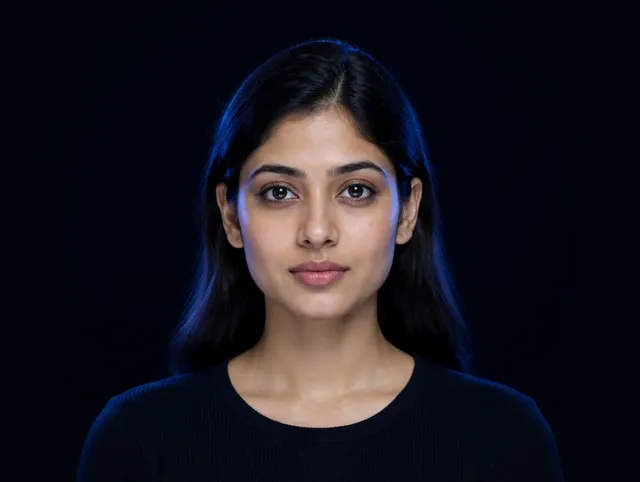
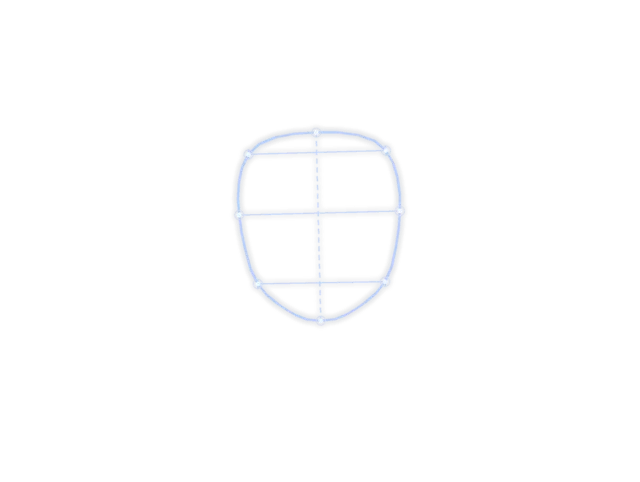
The detector measures the outline of your face and matches it to six common shapes: oval, round, square, heart, diamond and oblong. You get the closest shape, the runner-up, and the widths and length that drove the call. Face shape is a description, not a rating, so no shape scores higher than another.
How to read your result
The big word is your closest shape. The badge tells you how clear the match is:
- Clear match: one shape holds most of the share and the next one is far behind.
- Leans oval (or another shape): one shape leads, but a second one is close. Advice for the leader fits best, and some of the runner-up's advice fits too.
- Blend: two shapes are almost tied. This is common and not an error. Your face sits near a boundary, so use the advice for both.
The percentages under the result are shares of the six profiles. The detector measures how far your four measurements sit from each profile and turns those distances into shares that add up to 100. They are not the chance that a stylist would agree.
Below the bars, your own outline is drawn over the profile you tap, scaled to the same cheek width. This shows exactly where you differ, for example a jaw that is wider than the oval profile or a forehead that is narrower.
The measurements are shown as plain descriptions, such as "broader jaw" or "typical length", not as strengths or weaknesses. A wide jaw, a narrow chin or a long face is part of a shape, not a flaw, for men and women alike.
The six face shapes and how each is defined
Every face shape guide uses the same four inputs: face length, forehead width, cheek width and jaw width. The shapes are combinations of those four.
| Shape | Length ÷ width | Forehead | Jaw | Chin |
|---|---|---|---|---|
| Oval | 1.20 | 93% | 78% | 69% |
| Round | 1.07 | 92% | 79% | 72% |
| Square | 1.10 | 95% | 85% | 75% |
| Heart | 1.17 | 96% | 74% | 65% |
| Diamond | 1.19 | 88% | 75% | 66% |
| Oblong | 1.29 | 94% | 82% | 72% |
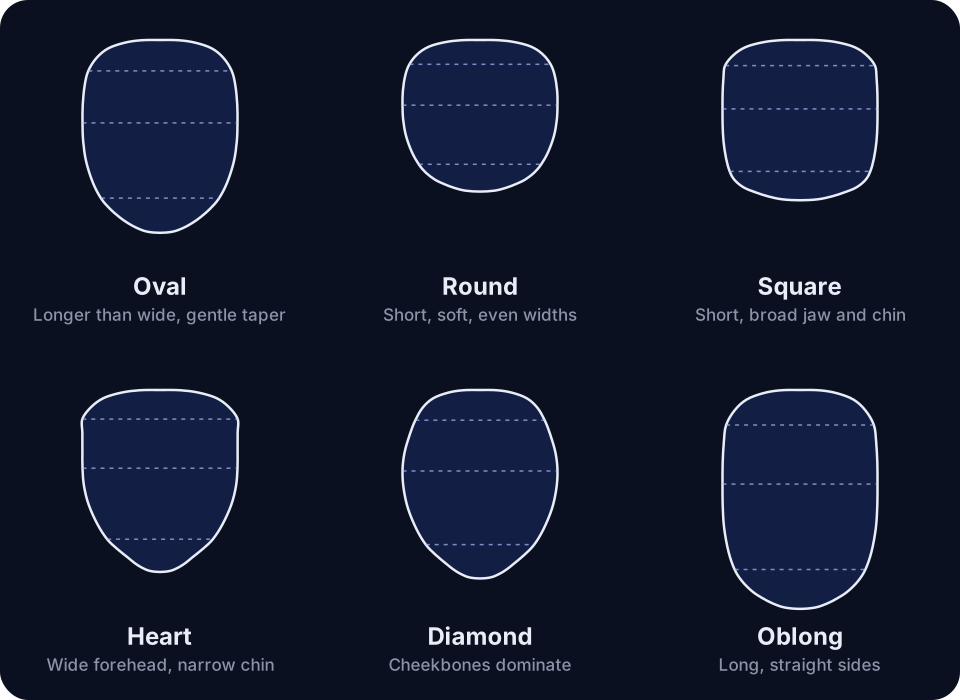
These are the actual targets the detector compares you with. Forehead and jaw are shares of cheek width. Chin is a share of jaw width. Length is measured from the upper forehead, so the numbers are lower than the ratios in tape-measure guides (more on that below).
- Oval: longer than wide, widest at the cheekbones, with a gentle taper to the forehead and chin.
- Round: about as wide as it is long, with soft, even widths and full cheeks.
- Square: short to medium length, with a jaw almost as wide as the cheekbones and a broad chin.
- Heart: a wide forehead and temples that narrow to a narrow, often pointed chin.
- Diamond: the cheekbones are clearly the widest line, and both the forehead and jaw are narrower.
- Oblong (also called rectangle): clearly longer than wide, with fairly straight sides.
Some guides add a seventh shape, the triangle or pear, with a jaw wider than the forehead. In this landmark layout the jaw-corner points sit well inside the temple points on a typical face (about 79% against 93% of cheek width), so the detector folds a broad lower face into square.
How the detector measures your face
The detector runs MediaPipe Face Landmarker, which places 478 three-dimensional landmarks on a face. It first levels your head tilt so that the line from forehead to chin is vertical. It then measures four ratios in pixels:
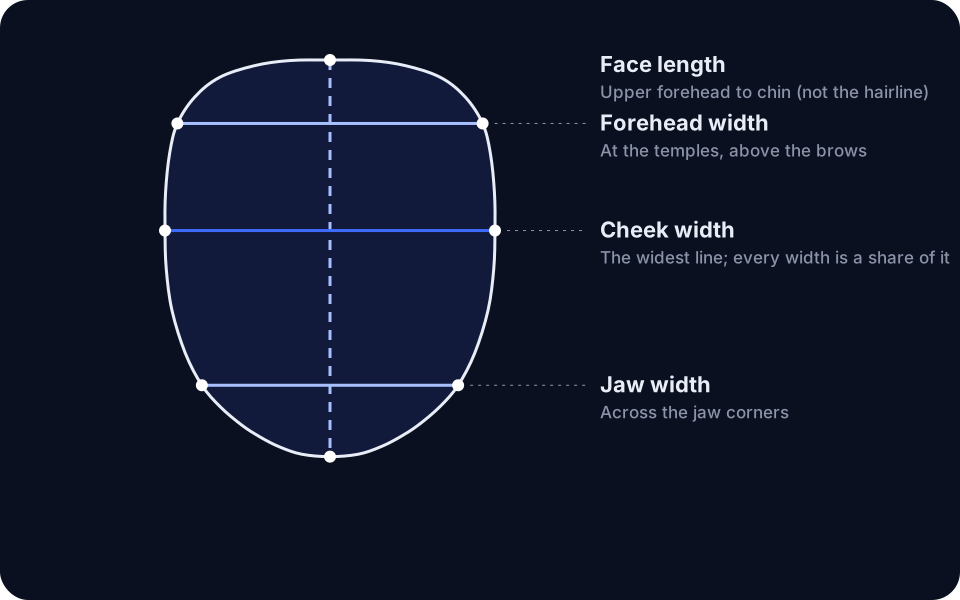
- Length ÷ width: upper forehead to chin, divided by cheek width. The cheek width is the widest line of the mesh outline, at cheekbone level.
- Forehead width: the outline at the temples, just above the brows, as a share of cheek width.
- Jaw width: the outline at the jaw corners, as a share of cheek width.
- Chin width: the outline just above the chin, as a share of jaw width. A low number reads as a pointed chin, a high one as a broad chin.
Each measurement is compared with a typical center. The detector treats a length ratio from 1.09 to 1.23 as the typical band. The center comes from the generic reference face that ships with MediaPipe, the canonical face model, nudged toward the front photos we tested. With the widths at the typical center, a length ratio below about 1.14 reads as round, and above about 1.26 reads as oblong.
What the mesh cannot see. The top landmark sits on the upper forehead, not at your hairline, because a hairline is hidden by hair or too soft to detect. So face length here always means upper forehead to chin. The forehead points also sit where hair often covers the face, which is why forehead width counts a little less than the other measurements.
These profiles are LooksLab's written version of common styling definitions. They have not been checked against a set of photos labelled by stylists, so treat the result as an estimate. Your photo is processed in your browser; it is not uploaded to measure your face.
Face shape in anthropometry
Styling shapes are a convention. Anthropometry, the science of measuring the body, has its own older system. It uses one number, the facial index: face height from the nasion (the dip between the eyes) to the chin, divided by the width between the cheekbones, times 100. Maalman and colleagues used these five bands:
| Facial index | Face type |
|---|---|
| 93 or more | Hyperleptoprosopic (very long) |
| 88–92.9 | Leptoprosopic (long) |
| 84–87.9 | Mesoprosopic (medium) |
| 79–83.9 | Euryprosopic (broad) |
| 78.9 or less | Hypereuryprosopic (very broad) |
The spread between groups is large. In that Ghanaian study of 387 adults, most participants were in the very long band. In a CT study of 100 Korean adults, 75 were in the very broad band and none were long. The two studies measured in different ways, which is part of the lesson: "long" and "broad" depend on who you compare with and how you measure. Any site that tells you the exact share of people with each face shape is guessing.
Automatic labels are fuzzy too. A research classifier built for hairstyle advice reached 70.3% accuracy at best across five shapes. A face-shape result is a useful summary, not a fixed fact.
How to measure your face shape by hand
A tape measure gives you a second opinion. You need a soft tape and a mirror, or a friend.
- Pull your hair back so your hairline, temples and jaw are visible.
- Forehead: measure across the widest part of your forehead, about halfway between your brows and your hairline.
- Cheekbones: measure across the widest point of your cheekbones, just below the outer corners of your eyes.
- Jaw: measure from one jaw corner, below the ear, to the other.
- Length: measure from the center of your hairline to the bottom of your chin.
- Find the widest of the three widths, then divide the length by the cheekbone width.
Styling guides usually call a face oval when the length is about one and a half times the width, measured from the hairline. Our length ratio starts lower on the forehead, so the same face gives a smaller number here. Also, a tape follows the curve of your face, so each width reads a little longer than a straight line would. Compare the pattern, not the exact numbers: which width is largest, and whether the face is clearly long or close to square.
What suits each face shape
Stylists work in two directions. One leans into your shape: short sides that show off a square jaw, slicked-back hair that shows diamond cheekbones. The other changes how the shape reads: height at the crown makes a round face look longer, width at the sides makes an oblong face look shorter. Neither direction fixes anything, because no shape needs fixing. These are stylist and optician conventions, not science. Texture, lifestyle and taste matter as much as shape. The glasses column follows All About Vision's frame guide.
| Shape | Hair | Glasses | Beard and brows |
|---|---|---|---|
| Oval | Most lengths work; keep part of the forehead open | Most frames; at least as wide as the widest part of the face | Any beard length; natural brow arch |
| Round | Height at the crown, side parts; soft, rounded cuts lean into the curves | Angular frames: narrow or wide rectangles | Longer at the chin, short at the sides; angled brow arch |
| Square | Short sides or blunt jaw-length cuts show the jaw; soft layers soften it | Rectangular or browline frames repeat the lines; narrow ovals soften them | Crisp edges along the jaw, length at the chin; soft brow arch |
| Heart | Volume at jaw level, side-swept fringe; flat crown | Wider at the bottom, or thin and rimless | Fuller at the chin and jaw; soft brows |
| Diamond | Fringe or forehead volume, fullness at the chin | Oval, cat-eye or browline frames | Fill the chin and jaw; straighter brows |
| Oblong | Width at the sides, fringe; extra height adds length | Frames with more depth, or bold temples | Fuller sides, short chin; flat brows |
If your result is a blend, read both rows.
From your result to your styling plan
The card under your result is built from your own measurements. It names your shape, or both shapes if you are a blend, and the measurement that stands out most. A square face with a jaw well above the typical width reads "Style for your square face: strong, broad jaw"; a diamond face with a narrow forehead and jaw reads "standout cheekbones". If no single measurement sits far from the typical center, the card names the shape's signature instead, such as balanced, gently tapered lines for oval. The text lists hair, glasses and beard or brow choices for that shape, and the button continues to LooksLab, where you can build a personal plan.
After you have your shape, the face symmetry test and canthal tilt test cover the features that shape does not describe, such as eye angle and left-right balance.
Why your result can be off
Most wrong results come from the photo, not the face.
- Camera distance. Close photos warp faces. In a Caltech study, faces photographed from close range had a smaller width-to-height ratio, so they looked thinner, than the same faces photographed from farther away. A Rutgers and Stanford model found that a selfie at about 12 inches makes the nose base look about 30% wider, relative to the cheekbones, than a photo at 5 feet. A close selfie can push you toward oval or oblong. Hold the phone at arm's length or use a timer.
- Head pose. Tilting your chin up or down shortens the face in the photo. Turning your head makes one side narrower. The detector removes sideways tilt, and the page warns you when your head is turned.
- Expression. An open mouth or a big smile moves the chin down and lengthens the face. The detector flags an open mouth.
- Hair, beard and glasses. Hair over the temples or jaw hides the outline the mesh fits to. A full beard can widen the lower face. Frames sit over the temples.
- Lighting. Strong shadows along the jaw can move the fitted outline.
For a clean retake, follow the photo guide for face analysis: straight on, camera at eye level, neutral face, hair back and soft light.
What can change and what cannot
Your bones set the frame. The cheekbones, jaw angles and chin do not change with styling, and nothing in a grooming routine reshapes them. With age, parts of the facial skeleton slowly lose bone, including the midface and the jaw in front of the jowls, as Mendelson and Wong describe.
Soft tissue changes faster. Coetzee and colleagues found that body mass index tracked the width-to-height ratio and the cheek-to-jaw width ratio of faces in photos. Those are the same kinds of ratios a face shape detector reads. So losing or gaining weight can move a borderline result, for example between round and oval. See how to lose face fat for how much weight that takes.
The biggest levers you control are presentation: haircut, beard shape, brow shape, glasses and how you take photos. They do not change your face shape, but they change which parts of it people notice first.
Face shape is not a score
No shape is better than another. If you want a measured look at proportions rather than a category, the attractiveness test and PSL scale test show the factors behind a rating, and the golden ratio face calculator compares your ratios with 1.618 and with what research actually supports. All of these results are app estimates from one photo, not objective measures of worth or medical facts.
Frequently asked questions
What is my face shape?
Your face shape is a short description of four measurements: how long your face is compared with its width, and how wide your forehead, cheekbones and jaw are compared with each other. Add a front photo to the detector above to measure all four at once and see which of six shapes you sit closest to. If two shapes come out close, you are a blend, and styling for both applies.
How do I know what shape my face is without a tool?
Pull your hair back, face a mirror straight on and trace your outline on the glass with a washable marker or a bar of soap. Then check two things: whether the outline is clearly longer than it is wide, and which line is widest, the forehead, the cheekbones or the jaw. A soft tape measure gives numbers for the same checks, as the hand-measuring steps on this page show.
What glasses shape is best for my face?
Optician guides mostly use contrast: angular frames for round faces, narrow ovals or softer frames for square faces, frames wider at the bottom or rimless frames for heart faces, oval, cat-eye or browline frames for diamond faces, and deeper frames for oblong faces. Oval faces suit most frames. Fit matters as much as shape, so pick a frame about as wide as the widest part of your face.
What haircut is best for my face shape?
Stylists pick cuts that either lean into your shape or change how it reads. Height at the crown lengthens a round face, width at the sides shortens an oblong one, volume at chin level suits a heart face, and short sides or a blunt cut at the jaw show off a square jaw. Hair texture, your hairline and how much time you want to spend styling matter as much as shape.
Is face shape different for men and women?
The six shapes and the four measurements are the same for everyone, and this detector does not ask your sex. What differs is how people usually style them: a beard changes the lower outline for many men, while hair length, fringes and brows do more of the work for many women. A broad jaw or a narrow chin is simply part of a shape, for anyone, and neither is a flaw.
What is a masculine face shape?
Square and oblong faces are often called masculine, because on average men have a larger jaw and chin and a longer lower face than women. That is an average difference with a lot of overlap, not a rule. Men have every face shape, and a beard shape or haircut changes how angular a face reads far more than a shape label does.
What is the most common face shape?
There is no dependable answer. Styling sites often say oval, but they rarely cite data, and every tool draws its boundaries differently. The one standard classification with published population data, the anthropometric facial index, varies a lot by group: in one Ghanaian study most adults had very long faces, while in a Korean CT study most had very broad faces.
What is the rarest face shape?
Nobody knows, because no study has counted styling face shapes in a large, representative sample of people. Sites that name diamond or another shape as the rarest, with an exact share of people, do not cite data for it. How rare a shape looks also depends on where each tool draws the lines between shapes, and those lines differ from one tool to the next.
What is the most attractive face shape?
No face shape is more attractive than another. Face shape describes proportions; it is not a score. Research on attractiveness points to overall features such as averageness and symmetry, and admired faces exist in every shape category. Use your shape to make styling choices, not to rank your face.
Can your face shape change?
Your bone structure is stable in adulthood and changes only slowly with age. What changes faster is the soft tissue on top of it: body fat, especially around the cheeks and jaw, changes the ratios a detector reads. Hair, beard and glasses change how the outline looks without changing it. A borderline result can move from one shape to the next after a weight change.
How accurate are face shape detectors?
The measurements are repeatable for the same photo, but the labels are fuzzy. Even a research classifier built for hairstyle advice was right about 70 percent of the time at best across five shapes. Treat any result as an estimate, check how close the runner-up is, and retake the photo if the result surprises you.
Can I have two face shapes?
Yes. Many faces sit near a boundary, for example between oval and oblong or between round and square. The detector shows how close all six shapes are and calls the result a blend when the top two are almost tied. A blend is not an error. Use the styling advice for both shapes, and look at which width or length made the call close.
How many face shapes are there?
There is no official number. Most guides use six or seven: oval, round, square, heart, diamond and oblong, often with triangle or pear added, and a few add rectangle or inverted triangle. This detector uses the six shapes that nearly every guide shares. It counts a broad lower face as square, because in this landmark layout the jaw corners rarely measure wider than the temples.
What is the difference between an oval and an oblong face?
Both are longer than they are wide. An oval face tapers gently toward the forehead and chin, with the cheekbones as the widest line. An oblong face is longer still and has straighter sides, so the forehead, cheeks and jaw are closer in width.
How do I know if I have a round or a square face?
Both are short compared with their width. A square face has a jaw nearly as wide as the cheekbones and a broad chin. A round face has a softer, narrower jaw and fuller cheeks, so the cheeks are clearly the widest line.
Why do face shape tools give different answers?
There is no shared standard. Tools use different landmark models, measure face length from different starting points, such as the hairline or the upper forehead, and set their own boundaries between shapes. A face near a boundary can land on either side. That is why this detector shows how close every shape is, not only the winner.
Can I use a selfie to find my face shape?
Yes, if you take it with care. Hold the phone at arm's length or farther, at eye level, with a neutral face and your hair off your forehead and jaw. Close selfies distort the face: the nearer the camera, the thinner a face tends to look, which can push a result toward oval or oblong. A timer and a steady surface help.
Is my photo uploaded or saved?
No. The face landmarks and measurements are computed in your browser, and the photo is not sent to a server to measure it. If you choose to create a public share link, only the result card image is stored, for 30 days, and it shows your face only if you opt in. A card you download stays on your device.