LooksLab guide
Weak Chin: What It Is and What Can Change
Learn what a weak chin means, how it differs from a recessed jaw or double chin, and what photos, beard styling, filler and surgery can change.
A weak chin is an everyday description of a chin that looks small or set back, especially in side profile. It can come from the chin itself, the position of the whole lower jaw, or the soft tissue around it, so judging your own photo cannot tell you which option, if any, fits (chin assessment, jaw evaluation). Filler adds temporary volume, surgery can add projection or move the chin bone or jaw, and mewing does not reshape the jaw.
This guide is for adults 18+. Start with one question: is the concern the tip of your chin, your whole lower jaw, or the outline beneath it? You can explore that question without deciding to change your face.

Fictional illustration, not a patient or a treatment result.
What is a weak chin, and is a flat chin the same thing?
“Weak,” “flat” and “receding” describe an appearance. They do not identify which structure accounts for it. These clinical terms are more specific:
- Microgenia: a small or receding chin; it can coexist with a normal bite. MedlinePlus.
- Retrogenia: reduced forward projection of the chin. Chin-assessment reference.
- Mandibular retrognathia: the lower jaw itself sits farther back in the side view. Retrognathia reference.
“Flat chin” needs clarification: do you mean a flat-looking front outline, a small chin, or a chin that sits back in profile? Chin assessment considers width, height and forward projection separately, alongside the surrounding features. Clinical assessment.
Weak chin vs strong chin: what is the difference?
In everyday appearance language, a “strong chin” means a more prominent or clearly defined chin; “weak” describes less prominence. Use those words to describe what you notice, not as a verdict on your face. More projection is not a goal you have to maximize.
A useful description is “the tip looks set back in profile.” That gives you something specific to ask about, without deciding that the rest of your face is wrong.
The nose changes how the chin reads: a more projected nose tends to make the chin look less projected, and vice versa. Chin assessment.
Do I have a weak chin, a recessed jaw or a double chin?
Use this table to choose a question. More than one row may fit; none selects a treatment for you.
| What you notice | What needs separating | Useful next question or check |
|---|---|---|
| “Just the tip of my chin looks set back” | Chin size/projection from whole-jaw position | Is the concern limited to chin contour? |
| “My lower jaw and teeth seem far back” | Skeletal jaw position from the dental bite relationship | What does an orthodontic examination show about each? |
| “I have a double chin at a normal weight” | Chin projection from fat below the chin and the surrounding contour | Is fullness, limited projection or a combination contributing? |
| “It looks different when I tuck or lift my head” | Your photo pose from your usual relaxed profile | Retake with a comfortable, level head before comparing. |
| “It only looks weak in some selfies” | Camera setup from the feature you want to assess | Keep camera, distance, light and expression consistent. |
| “My chin looks narrow from the front” | Frontal width from forward projection | Record the front-view concern separately from the side view. |
The chin-versus-jaw distinctions follow clinical chin assessment and the retrognathia reference. The capture rows are practical observation suggestions, not diagnostic tests.
A double-chin appearance does not automatically establish excess fat. Surgeon Matthias Solomon describes how a short or narrow chin can create that appearance even without fat deposits beneath it. This is a clinician's explanation, not a way to identify your tissue from a selfie. Chin and neck contour.
If fullness is your concern, our guide to facial fat, puffiness and structure helps organize that separate question. Do not make further weight loss your default answer to a profile you dislike.
If the concern extends to your upper jaw or central midface, use the flat maxilla guide. Keep the location clear before comparing options.
How can I check my side profile without guessing?
Make one consistent photo record and write a short note. You are recording an appearance to discuss, not producing a diagnosis.
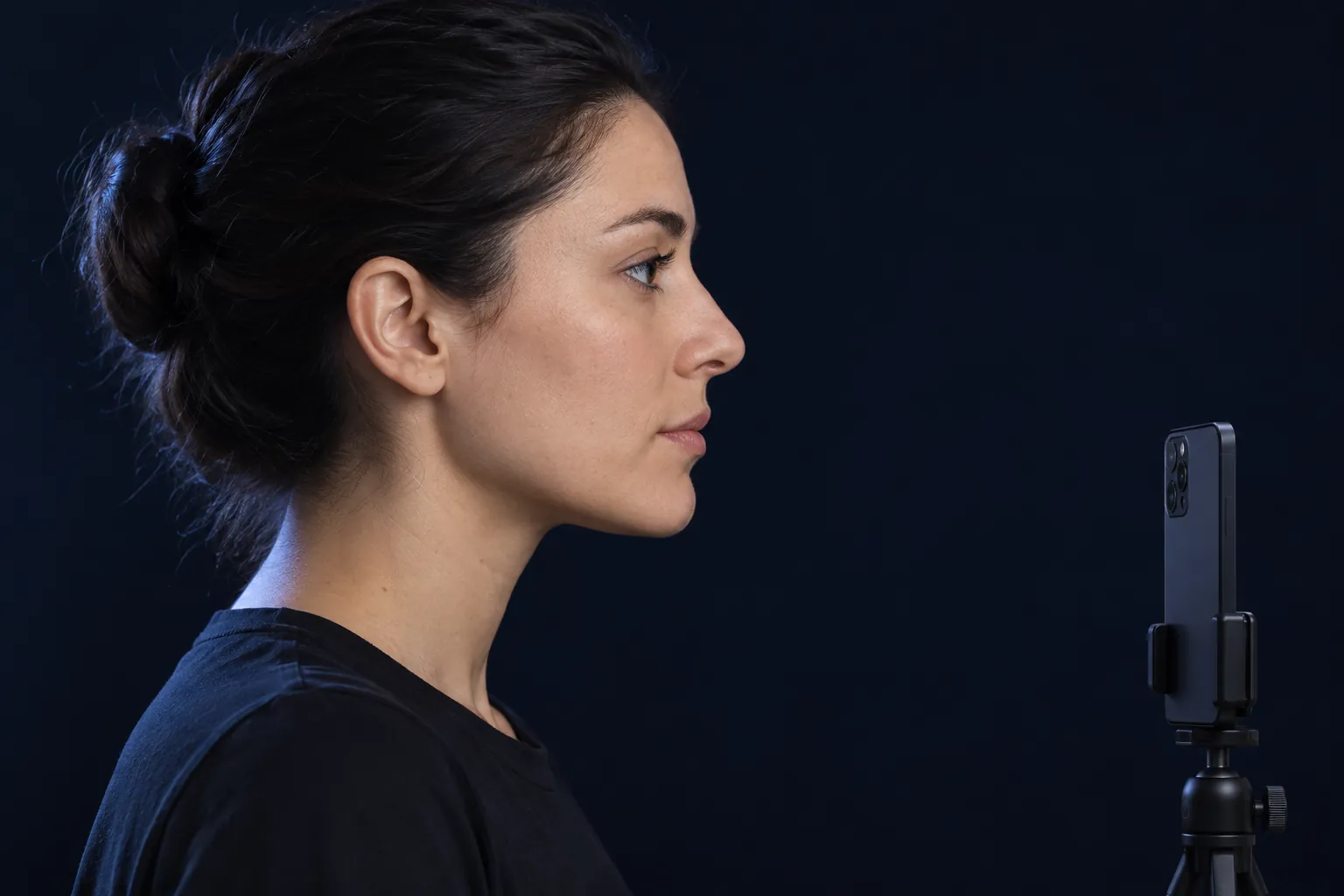
Fictional profile illustration. For your own record, place the camera at eye level and aim it at the side of your face.
- Set a steady camera at eye level. Use a tripod, timer or helper. Leave room around your head instead of taking an extreme close selfie.
- Take a true side view. Look straight ahead while the camera faces the side of your head. Keep your nose, lips, chin and chin-neck outline visible.
- Relax your jaw and lips. Keep your head comfortably level. Do not jut your jaw, tuck your chin or clench to manufacture a different outline.
- Use even light and no beauty filter. Save the camera, lens, distance, height and light setup for any later comparison.
- Take a separate frontal photo for tools. A profile record and a front-photo analysis answer different questions.
Our front-and-side photo guide explains the setup. Use this short worksheet with it:
| Record | Example note |
|---|---|
| Setup | Same phone and lens; eye-level camera; soft light |
| What I notice | The chin tip looks set back in the side view |
| Change with capture | More noticeable in my close selfie than this frame |
| Bite or function | My bite feels comfortable; no chewing concern noticed |
| Question to ask | Is this chin contour, lower-jaw position or soft tissue? |
This is a hypothetical example, not a patient result. “My bite feels comfortable” is useful history, but not a clearance test: teeth can compensate for a skeletal discrepancy. Dental compensation.
Is there a measurement or line I can draw?
A line on a photo cannot settle the bone-and-bite question. Clinical assessment considers the chin in three dimensions and in relation to the lips, teeth, nose and neck. Diagnosis of jaw position uses an examination and, when indicated, a lateral cephalometric X-ray. Whether imaging is needed depends on the concern and is the clinician's decision. Chin assessment, jaw evaluation.
Bring the photo and your question to an orthodontist if you have persistent bite or chewing concerns. If you also have breathing or sleep concerns, bring those to a healthcare professional separately rather than trying to interpret them through your chin photo.
Why does my chin look weak?
The British Orthodontic Society says research suggests lower-jaw position and length are governed by genetic make-up.
Growth history also matters to assessment. Previous head or neck surgery or trauma can contribute to retrognathia in some people. These are contexts a clinician asks about, not causes you can assign from your outline. Clinical history and development.
Soft tissue around the chin, including the area beside it along the jawline, also shapes the outline. Chin assessment.
You do not need to blame a childhood habit or search for something you did wrong. The more useful task is identifying which structure, if any, needs attention now.
How can you fix a weak chin without surgery?
First define the change you want: different styling, added chin volume, or a different jaw position. A nonsurgical option for one is not automatically an option for the others.
| Your goal | What to consider | Boundary |
|---|---|---|
| A different visible outline | Beard styling, haircut or makeup choices | Presentation choices, not skeletal treatment |
| A fairer photo comparison | Consistent camera setup and relaxed head position | A capture change does not demonstrate bone movement |
| Added chin volume | Clinician assessment for HA filler | Temporary soft-tissue augmentation; it does not advance the lower jaw |
| A bite concern | Orthodontic assessment | Moving teeth is different from moving the jaw skeleton |
The first two rows are styling and capture suggestions. The medical distinctions follow FDA chin-filler guidance and British Orthodontic Society guidance.
Does mewing fix a weak chin?
No. Mewing does not change adult chin bone or correct a recessed jaw. Cleveland Clinic explains that the tongue exercise lacks the strength and specificity to significantly reshape facial features, and may worsen jaw tension or temporomandibular joint problems. Mewing evidence.
Do not use gum chewing, chin or jaw exercises, or bone smashing as a chin treatment; our gum-chewing evidence review examines the evidence. There is no exercise routine to follow here.
Can braces fix a receding chin?
Braces address teeth and bite relationships; a more forward chin-bone position is a different treatment goal. Ask an orthodontist what the proposed changes would be in your teeth and jaw separately.
Growing-patient appliances are not an adult home alternative. The British Orthodontic Society says functional appliances primarily tip teeth and cautions that a significant long-term change in jaw position is unlikely. Functional-appliance evidence.
What do filler, chin implants and jaw surgery actually change?
These are options to understand, not recommendations to get a procedure. You can also choose no cosmetic treatment.
| Option | What it changes | Duration, recovery and risks |
|---|---|---|
| Hyaluronic-acid chin filler | Adds soft-tissue volume; does not reposition the jaw | Temporary; duration varies and repeat treatment may be needed. Rare vascular complications can cause tissue death, blindness or stroke. |
| Chin implant | Adds chin projection and contour in front of the existing chin bone | Surgical augmentation. An implant can shift; infection may require removal. Altered sensation is possible. Not a fix for a recessed jaw with a bite problem; best suited to a normal bite. Chin-assessment reference, MedlinePlus. |
| Sliding genioplasty | Moves your own chin-bone segment, secured with plates and screws | Structural surgery. Risks include infection, healing or hardware problems, altered lower-lip/chin sensation and anesthesia complications. |
| Lower-jaw advancement, such as BSSO | Repositions the lower jaw rather than only the chin segment; often coordinated with orthodontics | Major surgical care. Swelling and lower-lip numbness can occur; sensory recovery may take weeks or months. |
Sources: FDA filler benefits and risks, chin implants, sliding genioplasty, myFace's BSSO guide.
Age and suitability matter. FDA-approved dermal fillers, including the Restylane Defyne chin indication, are for adults over 21 (FDA), so an 18–21-year-old reader is outside that approval. Chin-augmentation assessment also considers completed skeletal growth and normal jaw/tooth alignment. Candidate assessment.
Recovery is not one fixed deadline. Cleveland Clinic says swelling and bruising after chin augmentation can last a few weeks. Ask separately about returning to work, activity restrictions and settling of the result. Recovery guidance. The BSSO guide's weeks-to-months sensory timeline is not a guarantee that all numbness resolves.
Fat reduction has a different target. Kybella, or deoxycholic acid, is FDA-approved to reduce fat under the chin in adults; that approval does not cover other body areas. It does not advance chin bone. Ask a clinician whether fat is actually contributing before considering a fat-targeted treatment. FDA guidance.
Before considering a procedure: For filler, see a licensed clinician experienced in dermatology or plastic surgery. For implants or bone surgery, see a plastic or oral and maxillofacial surgeon. Involve an orthodontist for bite or jaw-position concerns. Ask which tissue would change, what would remain unchanged, and what risks, recovery and follow-up apply to you. Do not inject yourself with filler or fat-dissolving products. FDA filler guidance, chin surgery, jaw care, FDA fat-dissolving injection guidance.
What beard suits a weak chin?
If you grow facial hair, consider a little more length at the chin with shorter sides. A short boxed beard, goatee or Van Dyke can be styling options depending on your coverage. Use the weak-chin beard and coverage guide to compare them; these are grooming suggestions, not a promise that one style suits everyone.
Bring a barber your relaxed side photo and ask for an outline you like and can maintain. If your beard is patchy, work with the growth you have rather than choosing a shape that depends on dense coverage everywhere. You can also keep a clean shave.
For hair or makeup, choose a framing change you enjoy. There is no need to turn every styling decision into an attempt to hide your chin.
Is a weak chin unattractive in men?
The label describes chin projection in profile, not a verdict on your attractiveness. A small or receding chin can coexist with a normal bite. MedlinePlus.
Can a face-analysis tool tell if my chin is recessed?
LooksLab's free tools use a front photo. None measures forward chin projection or diagnoses a recessed jaw.
- The face shape detector compares frontal outline ratios, including chin width relative to jaw width. Use it for styling context.
- The golden ratio face calculator includes vertical mouth-to-chin ratios. Height is a different measurement from forward projection.
- The attractiveness test shows measured frontal proportions, feature placement and symmetry, including men's jaw-to-cheek proportion. Skin and facial fat are unmeasured in this web test.
Scores are app estimates from one photo. Analysis runs in your browser, with the photo staying on your device during analysis. Keep your side-profile worksheet separate from the front photo you submit to a tool.
What should I do next?
Choose the question that matters to you. For a styling concern, try one grooming change. For an unclear profile, make the consistent photo record. For bite or chewing concerns, arrange an orthodontic assessment and bring your notes.
You can organize everyday grooming and skin habits with our guide to what softmaxxing can and cannot change, while leaving the procedure question open.
To organize your appearance goals, start your LooksLab plan: it gives you AI face analysis and a week-by-week glow-up plan built around what can change.