LooksLab guide
Female Looksmaxxing: What Works for Women + 12-Week Plan
Female looksmaxxing with sources: what skin care, makeup, hair, sleep and facial fat can change for women, what procedures risk, and a 12-week plan.
Female looksmaxxing, or looksmaxxing for women, means improving the parts of your appearance that can change, such as skin, makeup, hair, sleep and facial fullness, in a planned order. It cannot change your bone structure without procedures, and some methods that looksmaxxing women are told to try online do not work or are dangerous.
The short version:
- Start with skin. Daily sunscreen and one acne or retinoid product at a time have trial evidence and low risk.
- Sleep at least 7 hours. That is the CDC recommendation for adults. In experiments, faces looked more tired after a short night followed by 31 hours awake (Axelsson et al., 2010).
- Makeup is the fastest lever. In separate experiments, darker eyes and lips against the surrounding skin, and even skin tone, were each rated more attractive. The effect lasts only while you wear it.
- Facial fullness is linked to body weight in rating studies. Forum body-fat targets have no source; if you need to lose weight, do it gradually.
- Bone, eye tilt and feature spacing do not change with a routine. Mewing, gum chewing and bone smashing do not change them either.
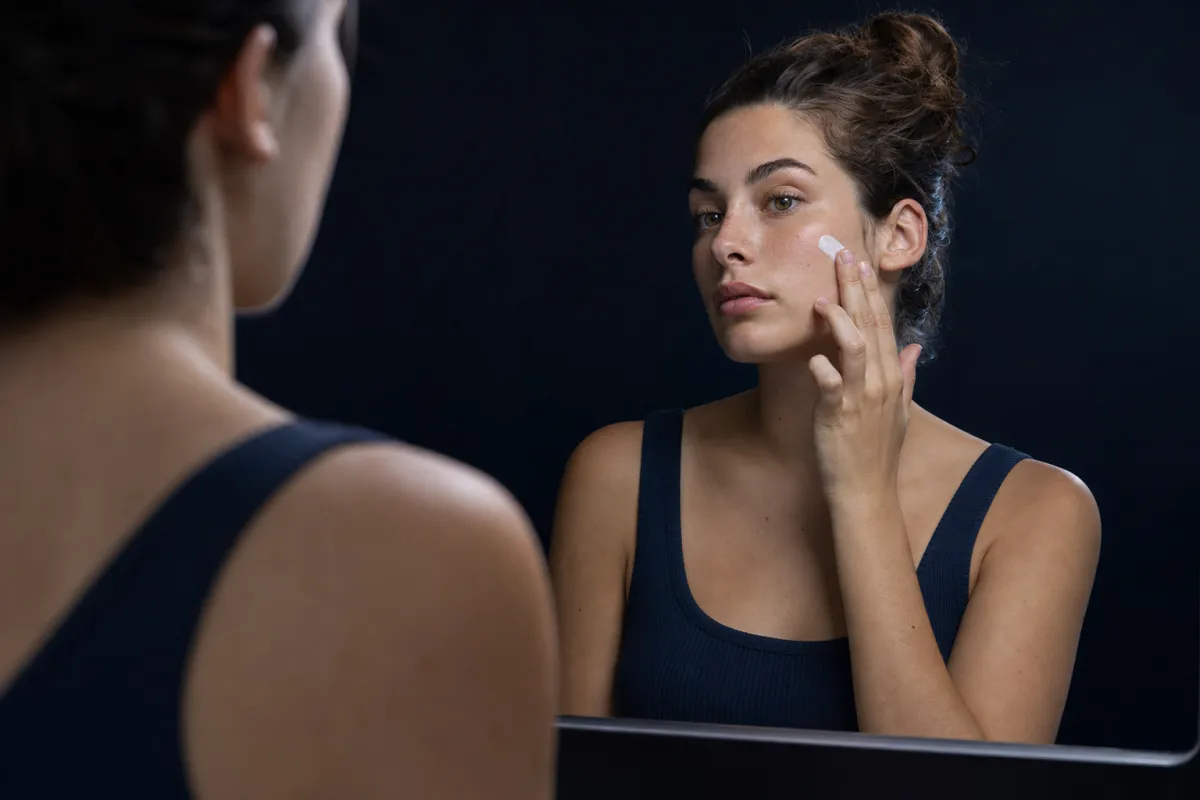
What looksmaxxing for women is
Looksmaxxing started as a mostly male online space. A Guardian call for readers' experiences describes it as having increasingly taken hold among women, with dedicated forums and apps where users have their features analyzed and scored to find areas to improve (The Guardian). On Reddit, r/Splendida hosts a widely shared female looksmaxxing guide.
The forums split the methods into two groups. Softmaxxing is what you do yourself: skin care, makeup, sleep, hair, posture and body composition (our softmaxxing guide covers it for everyone). Hardmaxxing means medical changes such as filler, Botox and surgery.
Becky, Stacy and Eve tiers explained
Forums rank women with slang tiers: "Becky" for average, "Stacy" for very attractive and "Eve" or "True Eve" for the rare top. A "true Stacy" is said to have both strong bone structure and polished skin, hair and makeup. Some sites attach percentages and "+1 point" gains to these tiers, but no measurement stands behind them. Research does find some agreement across cultures: faces close to the average of many faces, symmetrical faces and sex-typical faces are rated more attractive (Rhodes, 2006). A 2025 study that measured these traits together found that symmetry did not predict ratings once averageness was accounted for (more on that below).
Where to start: a five-question self-check
Answer yes or no. Your first "yes" is the first lever in your 12-week plan.
| Question | If yes, start here |
|---|---|
| Do you skip sunscreen on most days? | Daily SPF 30+ |
| Are breakouts, dark spots or uneven tone the first thing you notice in photos? | Skin routine |
| Do you often sleep less than 7 hours, or look puffy and tired in photos? | Sleep |
| Is your hair thinning, or your part getting wider? | A dermatologist visit |
| Do your cheekbones and jaw look soft because of fullness rather than bone? | Slow fat loss and strength training |
If you answered no to all five, start with makeup and hair.
Before and after: how long each change takes
No study gives a "points" gain for looksmaxxing. The table shows how long each change takes in the sources below. Makeup raises ratings, but the effect is small compared with the differences between faces (Jones & Kramer, 2015).
| Change | When it shows |
|---|---|
| Makeup, a haircut | The same day |
| A new acne product | Fewer breakouts after 4–8 weeks; clearer skin at about 16 weeks (AAD) |
| More fruit and vegetables | Skin yellowness and redness changed within 6 weeks in a small study (Whitehead et al., 2012) |
| Niacinamide | Tested over 12 weeks (Bissett et al., 2005) |
| Fat loss | In one study with altered face photos, viewers rated women's faces more attractive after a BMI drop of about 2.4 (Re & Rule, 2016), about 14 pounds for a woman of average height (University of Toronto). At 1–2 pounds a week, the pace the CDC links with keeping weight off (CDC), that takes about 7 to 14 weeks |
| Hair-loss treatment (minoxidil) | About 6–12 months before you can judge it (AAD) |
| Daily sunscreen | Prevention over years (Hughes et al., 2013) |
The forum vocabulary, and what can change
| Term | What it means | Forum "ideal" | Can a routine change it? |
|---|---|---|---|
| Canthal tilt | The angle from the inner to the outer eye corner | Positive (outer corner higher) | No. Eyeliner and lash curling can change how it reads in a photo. Measure yours with the canthal tilt test. |
| Facial thirds | Forehead, nose and lower face compared by height | Equal | No. Hair can cover the forehead. The golden ratio face calculator measures your thirds. |
| Midface | The area between the eyes and the upper lip | Compact | No, it is set by bone structure |
| Cheekbones | The bone under the outer cheek | High | The bone, no. Lower facial fat can show more of it, and blush or contour can shade it. |
| Cupid's bow | The double curve at the center of the upper lip | Defined | No. Lip liner can outline it. |
| Facial fullness | How much fat the face carries | Low enough to show structure | Partly, through body fat, over months |
| Skin | Evenness of tone and texture | Even and clear | Yes, over weeks to months |
| Symmetry | How closely the left and right sides match | High | Mostly no. Head position and light change it in photos. Check it with the face symmetry test. |
What our attractiveness formula weighs in a woman's face
Our free attractiveness test scores faces with the same formula as the LooksLab app. The weights are our own design. We chose them with this finding in mind: in a 2025 study that measured these traits from face photos, averageness predicted ratings of men's and women's faces and femininity predicted ratings of women's faces, but symmetry did not (Lee et al., 2025). The study gives no percentages, and it did not test facial fat or skin: the fat, skin and femininity weights are our product choices, not numbers from a study. These are our weights for women:
| Factor | Weight for women | Can you change it without surgery? |
|---|---|---|
| Averageness (closeness of your face proportions to typical values) | 45% | No, it is mostly set by bone structure and feature proportions |
| Facial fat | 20% | Partly, through body fat |
| Femininity | 15% | No (the test does not measure it yet) |
| Skin evenness | 12% | Yes |
| Symmetry | 5% | Mostly no |
| Feature placement (eye tilt, nose and mouth centering) | 3% | No |
Two things follow. First, the factors a routine can change, facial fat and skin, carry 32% of the formula, more than symmetry and feature placement together (8%). Second, the bone-based factors carry most of the weight, so a routine changes the parts in between rather than the whole score. A front photo cannot measure facial fat, skin or femininity from face landmarks, so the free test marks them "not measured" and scores the rest. The score is an estimate from one photo, for adults 18 and over.
What the research supports
"Type" is the kind of study behind each lever. "Time in the study" is how long the study ran or when it measured a change; it is not a promise for your face.
| Lever | Type | What the study found | Time in the study |
|---|---|---|---|
| Daily sunscreen | Randomized trial | In 903 Australian adults under 55, daily users showed no detectable increase in skin aging (graded from skin-surface texture on the back of the hand, not face photos), and 24% less aging than people who used sunscreen at their own discretion (Hughes et al., 2013) | 4.5 years |
| Niacinamide 5% | Randomized split-face trial | Fewer fine lines, dark spots, red blotches and less sallowness in 50 white women (P&G-funded) (Bissett et al., 2005) | 12 weeks |
| Retinoids | Review | Improve sun-aged skin. Tretinoin is the most studied and possibly the most potent; retinol and retinaldehyde irritate less (Mukherjee et al., 2006) | Varies |
| Vitamin C serum | Review | Can treat and help prevent sun-related aging and dark patches if the formula is stable (Telang, 2013) | Not stated |
| Fruit and vegetables | Small study | In 35 white participants, skin yellowness and redness followed diet changes; the authors estimated about 3.3 more portions a day for a visibly more attractive color (Unilever-funded) (Whitehead et al., 2012) | 6 weeks |
| Eye and lip contrast | Image experiment | Female faces were rated more attractive when the eyes and mouth were darker compared with the surrounding skin (Russell, 2003) | Same day |
| Makeup overall | Rating experiments | Raised attractiveness ratings at a glance and with longer viewing (P&G-funded) (Etcoff et al., 2011); the effect is small compared with the differences between faces (Jones & Kramer, 2015) | Same day |
| Even skin tone | Rating experiment | Female faces with even skin color were rated younger and more attractive (Fink et al., 2008) | Same day |
| Short sleep | Experiments | After 31 hours awake following a short night, faces were rated less healthy and slightly less attractive (Axelsson et al., 2010), with more swollen eyes, darker circles and paler skin (Sundelin et al., 2013) | One night |
| Facial fullness | Rating study | Perceived facial weight was linked with ratings of health and attractiveness (Coetzee et al., 2009) | Not measured |
| Posture in photos | Field experiment | On a dating app, people in expansive, open poses were chosen more often; the authors suggest one reason was that the poses looked more dominant (Vacharkulksemsuk et al., 2016) | Same day |
Only the skin-care rows test a treatment over weeks or years. The other studies show what people notice in faces, not how much one person's face will change.
How to use each lever
Skin
- Sunscreen every morning. Use broad-spectrum SPF 30 or higher (AAD). Its benefit is prevention over years, so photos will not show it soon.
- If you have breakouts, one acne product first. For mild adult acne, dermatologists recommend non-prescription adapalene (a retinoid), benzoyl peroxide (start with 2.5%), azelaic acid or salicylic acid. Use one product as directed for 6 to 8 weeks without adding another. Expect fewer breakouts after 4 to 8 weeks and clearer skin at about 16 weeks. Deep, painful or scarring acne needs a dermatologist, and if you are pregnant or trying to get pregnant, ask a dermatologist before you treat acne yourself, because some non-prescription treatments are not safe in pregnancy (AAD).
- If your goal is tone and texture, a retinoid at night. Retinol irritates less than tretinoin; for the best-studied option, ask a dermatologist about tretinoin. If you are pregnant or trying to get pregnant, ask a dermatologist before you start a retinoid too.
- Niacinamide or vitamin C once your skin tolerates the first product.
Add one product at a time, so you can tell which one causes a reaction. Do not pick at spots: picking makes acne take longer to clear and raises the risk of scars and dark marks (AAD).
Makeup
The research gives two principles:
- Contrast. Define the eyes and add lip color, so the eyes and mouth are darker than the skin around them (Russell, 2003).
- Evenness. Cover dark spots, redness and dark circles. Even tone is rated younger and more attractive (Fink et al., 2008), and dark circles are one of the cues people read as tiredness (Sundelin et al., 2013).
The techniques below are common makeup-artist practice, not tested in studies. Use them to apply the two principles:
| Technique | What it changes in a photo | Principle |
|---|---|---|
| Light base, with concealer only where needed | Even tone without a flat, heavy look | Evenness |
| Curled lashes and mascara focused on the outer lashes | Eyes look more open and slightly lifted at the outer corner | Contrast |
| Brows filled to their natural arch | A clearer frame for the eyes | Contrast |
| Lip liner close to your natural lip color, then lip color | A more defined lip line | Contrast |
| Blush on the upper cheek, toward the temple | Cheeks look lifted | Shading |
| Soft contour under the cheekbone | More shadow under the cheekbone | Shading |
Take makeup photos separately from bare-faced progress photos, so you do not mistake makeup for skin change.
Hair
Hair frames the face, and you can change it in one appointment. Stylists usually match the cut to the face shape. Our face shape detector measures your shape from a photo and uses these styling conventions:
| Face shape | What stylists commonly suggest |
|---|---|
| Oval | Most lengths work. An open forehead shows the length; a fringe or side part softens it. |
| Round | Height at the crown and a side part lengthen the outline. |
| Square | Soft layers and texture around the jaw soften the corners; blunt jaw-length cuts show them. |
| Heart | Volume at jaw and chin level and a side-swept fringe balance a wide forehead. |
| Diamond | Tucked or slicked-back sides show the cheekbones; a fringe or chin-level volume fills the narrower ends. |
| Oblong | Width at the sides and a fringe shorten how long the face reads. |
A widening part or a thinner ponytail can be female pattern hair loss, the most common cause of hair loss in women. Treatment works best when it starts early. Minoxidil is the most-recommended treatment, and it takes about 6 to 12 months of use to judge it. Avoid minoxidil if you are pregnant, planning a pregnancy or breastfeeding (AAD). See a dermatologist first, because other causes can look the same.
Sleep and puffiness
The CDC recommends at least 7 hours of sleep a night for adults (CDC). The looks studies tested one short night followed by 31 hours awake, not months of short sleep. After that, faces looked puffier around the eyes, darker under the eyes and paler. If you often look puffy and tired in photos, fix sleep before you buy eye products.
Body composition and posture
- Fat loss, if you need it: go slowly. People who lose about 1 to 2 pounds a week are more likely to keep the weight off (CDC). Ignore body-fat targets from forums; they have no source. Our guide to losing face fat shows how much weight change it takes before the face changes. Speak to a doctor or dietitian first if you have ever had an eating disorder.
- Strength training: adults need muscle-strengthening activity on at least 2 days a week (CDC).
- Posture in photos: open, expansive poses were chosen more often in the dating-app study above.
Grooming, style and teeth
Forum guides also cover grooming and style. These are personal choices rather than research questions, so take them as options:
- Brows: shaping or tinting them to your natural arch frames the eyes every day without makeup.
- Oily skin: blotting papers remove shine in photos without adding product.
- Hair removal, nails and lashes: do what you are comfortable maintaining; a routine you keep beats one you drop.
- Clothes: fit and comfort matter more than price. A few pieces that fit well read as polished.
- Teeth: if you want whiter or straighter teeth, ask a dentist which option fits your teeth before you buy a kit.
One forum guide ends on the same note: goals, skills and confidence outside your looks matter too.
Mewing, gum chewing and bone smashing
- Mewing (pressing the tongue to the roof of the mouth): the American Association of Orthodontists says there is no current research that suggests it provides any benefit to the jawline (AAO).
- Gum chewing: in a 6-month randomized trial, chewing gum three times a day made adults' bite stronger but did not significantly change jaw muscle thickness or jaw shape (Jung et al., 2024). Read what the gum trial found.
- Bone smashing (hitting the face to "strengthen" bone) does not work and can injure you (Michigan Medicine).
A 12-week female looksmaxxing plan
Add one lever every two weeks, in the order of your self-check "yes" answers. The default order is below. Take bare-faced photos in weeks 0, 6 and 12 with the same setup: same place, same light, camera at eye level, no filter. Our guide to taking photos for face analysis shows a setup you can repeat.

| Weeks | New lever (default order) | Check |
|---|---|---|
| 0 | Baseline photos, front and side. Write down your sleep and your products. | Photos in one folder |
| 1–2 | Daily SPF 30+ | SPF on 12 of 14 days |
| 3–4 | Sleep: a fixed bedtime and at least 7 hours | 7+ hours on most nights |
| 5–6 | One acne product, or retinol a few nights a week if you have no breakouts | Week 6 checkpoint: retake the photos and compare puffiness and tiredness |
| 7–8 | Makeup: contrast and evenness | Makeup photos in the same setup |
| 9–10 | Strength training twice a week; slow fat loss if fullness hides your structure | Weight change, if any, of 1–2 pounds a week or less |
| 11–12 | A haircut for your face shape; niacinamide or vitamin C | Week 12 checkpoint: retake the photos and compare them with week 0 |
At week 12, judge sleep, makeup and hair on the photos. An acne product may need until about week 16 to clear skin, sunscreen works over years, and retinoids and fat loss take months, so keep them going before you decide.
Hardmaxxing: procedures and their risks
| Procedure | What it is for | Main risks and limits |
|---|---|---|
| Dermal filler | Volume in the lips, cheeks or chin | FDA-approved for specific uses in adults 22 and older. Rarely, filler enters a blood vessel, which can cause tissue death, vision problems including blindness, or stroke. The FDA says not to inject yourself and not to buy filler online (FDA). |
| Buccal fat removal | Slimmer cheeks | One systematic review pooled 12 studies (308 patients) and estimated that about 1 in 4 had a complication, mostly swelling, limited mouth opening, pain or asymmetry, with a wide range between studies (Albuquerque et al., 2025). Another found mostly favorable results and 7 complications in 134 procedures, but called the evidence low quality with little long-term data (Traboulsi-Garet et al., 2021). |
| Botox in the masseter (jaw muscle) | A narrower lower face | In a placebo-controlled trial of 187 adults with marked masseter prominence, it reduced lower-face volume at 90 days; at the highest dose, 4 people had an effect on their smile (several authors work for the manufacturer) (Carruthers et al., 2025). |
| Unproven peptides | Sold online by influencers | Unproven, with unknown risks (Michigan Medicine) |
This table does not cover rhinoplasty, lip lifts or orthodontics. For those, ask a board-certified surgeon or an orthodontist about results and risks for your face.
Why doctors worry about the trend
Terrill Bravender, chief of adolescent medicine at University of Michigan Health, answered questions about looksmaxxing for parents. He says the trend has pulled in a lot of adolescent boys and young men; his point about watching yourself on video applies at any age (Michigan Medicine):
- When people see themselves constantly on video, they monitor themselves, and short-form video hooks young people more strongly than older social media did. Many teens and young adults take influencers' advice seriously.
- Forums measure features in millimeters against "perfect" ratios, which creates a winner-takes-all idea of beauty. Constant exposure may contribute to lower self-esteem and body dissatisfaction.
- Bone smashing and unproven peptides are dangerous; the article also lists stimulants taken to lose weight fast.
- Parents should watch for changes in behavior that may signal social isolation, and keep talking with their teen about what they see online.
- He does not think the harm is permanent. The goal is to feel comfortable with who you are.
Common mistakes
- Starting several products at once. If your skin reacts, you cannot tell which one caused it.
- Comparing photos taken in different conditions. A phone held close to your face makes your nose look larger (Rutgers).
- Judging sunscreen or retinoids after a few weeks. The sunscreen trial ran for 4.5 years.
- Picking at spots. It raises the risk of scars and dark marks.
- Losing weight fast. Gradual loss is more likely to last.
- Buying filler online or injecting yourself. The FDA warns against both.
- Treating a tier or a score as a verdict on yourself.
Track it with your own face
The plan above is the same for everyone. The hard part is choosing your first levers and keeping them going. The LooksLab plan has a path for women: it asks which area you most want to improve (jawline, skin, hair or bloating), scans a front selfie and builds a personal glow-up plan, and the app suggests a new scan every two weeks. The scan is an estimate from one photo, and head position and light affect it, so use the same setup each time. If you want the 12 weeks built around your own face, start your LooksLab plan. It is for adults 18 and over.
When to get help. If thinking about your looks takes up most of your day, or a score or a forum tier makes you feel worthless, take a break from the forums and talk to a doctor or someone you trust.
Common questions
How long does female looksmaxxing take to show results?
From the same day for makeup and a haircut to years for sunscreen. Most skin changes take 1 to 4 months; the "Before and after" table above lists each one.
Is the Becky, Stacy and Eve scale real?
No. It is forum slang with no measurement behind it, and the percentages some sites give it are not from data. A face score from an app is an estimate from one photo; use it to compare your own photos over time.
Can looksmaxxing change your bone structure?
Not without surgery. Mewing and gum chewing have no evidence of changing jaw shape in adults, and bone smashing can injure you. Lower facial fat can show more of the bone you have, and makeup can shade it.
Does looksmaxxing work for women?
Partly. Sunscreen and skin products have been tested in trials. Makeup, even skin tone, sleep and facial fullness affect ratings in experiments, but those studies show what people notice, not how much changing your habits will change your face. Nothing except surgery changes bone.